


Sometimes a production needs something that doesn’t exist.
Other times, it needs something that already exists—but doesn’t exist anymore.
A historically accurate architectural feature. A replica of a famous object. A fictional machine based on concept art. A one-of-a-kind artifact. An oversized reproduction of an everyday product. A highly specialized component that can’t be sourced anywhere.
That’s where replica and specialty fabrication comes in.
At Statement Fabrication, we build custom replicas and specialty fabricated pieces for film, television, commercials, branded productions, and other visual projects where an off-the-shelf solution simply isn’t good enough—or doesn’t exist at all.
We combine digital modeling, advanced fabrication technology, traditional craftsmanship, and specialty finishing to reproduce existing objects or bring completely original concepts into the physical world.
When “Off the Shelf” Isn’t an Option
Film and television productions routinely call for objects that aren’t available through conventional suppliers.
The object may be fictional.
It may be historically significant and impossible to obtain.
It may be too valuable, fragile, rare, large, or expensive to use during production.
Or perhaps the production needs ten identical versions of something that only exists once in the real world.
Whatever the reason, the solution often begins with fabrication.
Instead of searching endlessly for the right object, production teams can create it.
That could mean reproducing something that already exists, modifying an existing design, or engineering an entirely new object based on a creative concept.
Custom Replica Fabrication
Replica fabrication is the process of recreating an existing object or architectural element as accurately as the production requires.
Depending on the project, the goal may be complete visual accuracy or simply the appearance of the original object from the camera’s perspective.
Replica projects can include:
- Historical objects
- Architectural elements
- Furniture
- Sculptures
- Machinery
- Industrial components
- Product replicas
- Vehicles and vehicle components
- Signage
- Decorative elements
- Museum-style reproductions
- Oversized objects
- Fictionalized versions of real objects
The level of detail can be tailored to the production.
A background replica may only need to look convincing from a distance.
A hero replica may need to withstand close-up photography and repeated interaction.
The fabrication strategy changes accordingly.
Historical Replicas for Film & Television
Period productions often require an extraordinary amount of historical detail.
A production set in another era may need architectural elements, furniture, signage, machinery, decorative pieces, tools, or other objects that accurately represent the time period.
The challenge is that authentic originals may be impossible to obtain—or simply impractical to use.
A replica can provide the visual authenticity required by the production without the limitations associated with an original artifact.
Depending on the object, fabrication may involve digital modeling, CNC cutting, metalwork, woodworking, 3D printing, sculpting, molding, casting, fiberglass, or specialty finishing.
The final result can be designed specifically for the production and built to meet its practical requirements.
Architectural Replicas
Sometimes the thing that needs to be reproduced isn’t a small object.
It is a piece of architecture.
A distinctive column.
A historic doorway.
A decorative facade.
A sculptural architectural feature.
A section of a building.
An ornate molding or architectural detail.
Replicating architectural elements for film and television can allow production designers to recreate locations or visual details without reproducing an entire structure.
Large architectural replicas can be fabricated as individual components and assembled at the production location.
This approach can also allow historically accurate details to be recreated at a practical scale while using modern fabrication techniques and production-friendly materials.
Replicating Objects That Can’t Be Used on Set
There are many reasons an authentic object may not be suitable for production.
It could be:
Too valuable.
A production may not want to risk an irreplaceable original.
Too fragile.
Repeated handling and transportation can be hard on delicate objects.
Too rare.
There may be no practical way to obtain multiple originals.
Too heavy.
An authentic object may be impractical for actors and crew.
Too expensive.
Purchasing or renting the original may not make financial sense.
Unavailable.
The object may no longer be manufactured or may not exist at all.
A custom replica can solve these problems while preserving the visual characteristics the production needs.
Lightweight Replicas
One of the biggest advantages of modern fabrication is the ability to reproduce the appearance of a heavy or solid object without necessarily reproducing its weight.
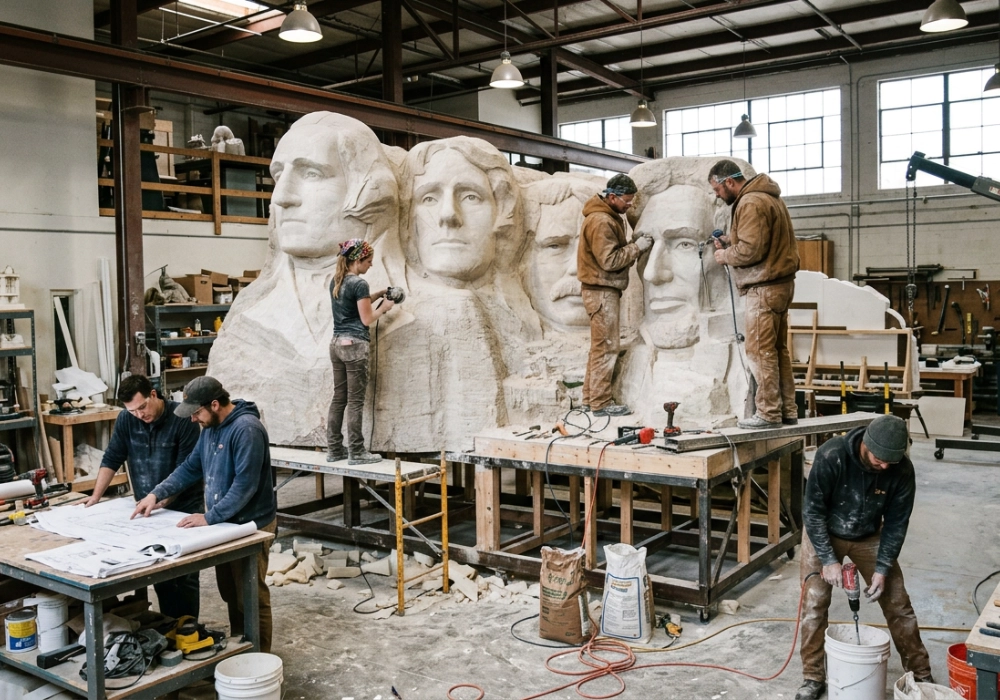
A stone monument could be fabricated from lightweight sculpted materials.
A metal artifact could be constructed using a lightweight core and finished to look like cast or machined metal.
A large architectural component could be fabricated from foam, fiberglass, composites, or a combination of materials rather than solid masonry.
This matters when an actor needs to handle an object or when a large piece needs to be transported and installed quickly.
The audience sees the illusion.
The production benefits from the practicality.
Specialty Fabrication for Objects That Don’t Exist
Replica work starts with something that already exists.
Specialty fabrication often starts with something that doesn’t.
A production designer may have a sketch of a fictional device.
A concept artist may create an elaborate object with no obvious real-world manufacturing method.
A director may want an enormous version of something ordinary.
A creative agency may need a completely unique physical object for a commercial.
These are the projects where conventional manufacturing can hit its limits.
Specialty fabrication takes the creative idea and asks:
How do we physically build this?
Sometimes the answer is straightforward.
Sometimes it requires several different fabrication disciplines working together.
From Concept Art to Fabricated Object
Specialty pieces frequently begin with digital artwork rather than technical manufacturing drawings.
That means the first challenge may be translating a visual concept into something that can actually be fabricated.
3D modeling can help establish dimensions, geometry, component relationships, assembly methods, and material requirements.
The digital model can then become the foundation for fabrication.
Depending on the project, that could lead to:
3D printing → CNC cutting → metal fabrication → foam sculpting → fiberglass → assembly → finishing.
This digital-to-physical workflow can make highly complex custom fabrication significantly more manageable.
3D Printing for Replica & Specialty Fabrication
3D printing is particularly valuable when a replica or specialty component contains intricate geometry that would be difficult to reproduce through conventional fabrication.
It can be used for:
- Detailed mechanical components
- Decorative elements
- Sculptural objects
- Small replicas
- Custom enclosures
- Fictional technology
- Architectural details
- Replacement components
- Prototypes
- Repeated parts
Because the geometry originates digitally, modifications can often be made without rebuilding the entire design from scratch.
This makes 3D printing useful not only for final pieces, but also for prototyping and testing.
CNC Fabrication for Precise Reproduction
CNC technology can provide another level of precision when reproducing complex shapes or producing multiple identical components.
Digital files can be translated into precisely cut parts from materials such as wood, plastics, foam, composites, and other sheet or block materials.
This is especially useful for large-scale replicas, architectural components, repeated elements, and complex sculptural forms.
Rather than manually reproducing every component, digital fabrication can provide consistency from the first piece to the last.
Foam & Sculptural Replicas
When a production needs something large, detailed, and lightweight, foam can be an exceptionally effective material.
CNC and robotic foam cutting can produce complex forms with a high degree of repeatability.
The resulting form can then be refined and finished to resemble:
- Stone
- Wood
- Concrete
- Metal
- Marble
- Carved sculpture
- Organic materials
- Fictional materials
This makes foam fabrication especially useful for oversized replicas, sculptures, architectural elements, fantasy objects, and large specialty pieces.
The finished object may look massive and solid on screen while remaining practical for production.
Metal Replicas & Specialty Fabrication
Some pieces need the strength and appearance of metal.
Statement Fabrication’s metal fabrication capabilities can be used to create custom frameworks, structural components, architectural details, machinery, specialty objects, and replicas.
Welding, tube fabrication, formed metal, CNC-cut components, and other processes can be combined to produce pieces ranging from functional structures to highly detailed visual objects.
Metal can also serve as the structural backbone beneath lighter scenic materials.
That combination can provide the best of both worlds: strength where it’s needed and reduced weight where it matters.
Fiberglass Replicas
Fiberglass is another highly versatile material for replica fabrication.
It can reproduce complex shapes while providing a durable, relatively lightweight shell.
Fiberglass can be used for architectural elements, sculptures, product replicas, large specialty pieces, vehicle components, and other fabricated forms.
It also provides an excellent surface for subsequent finishing.
A fiberglass piece can be made to look like metal, stone, wood, ceramic, plastic, or other materials depending on the desired result.
The Difference Is Often in the Finish
A replica can have the correct shape and still look wrong.
Why?
Because the surface doesn’t tell the same story.
A historically accurate object may need years of apparent wear.
A fictional machine may need a convincing industrial finish.
A replica of a stone sculpture may need subtle variation in color and texture.
A new object may need to look old.
A fabricated metal component may need to look cast, machined, polished, rusted, or weathered.
Specialty finishing is therefore a critical part of replica fabrication.
The fabrication creates the physical form.
The finish creates the visual history.
Building Multiple Versions
Productions often need more than one copy.
A single object may need to exist as:
- A hero version
- A stunt version
- A lightweight version
- A damaged version
- A background version
- Multiple identical production units
Modern digital fabrication makes this kind of replication more efficient.
Once the geometry and fabrication process are established, additional versions can be produced with a much greater degree of consistency.
That can be especially valuable when continuity matters across multiple scenes or shooting locations.
When Accuracy Matters
Replica fabrication exists on a spectrum.
Some projects require an object to be virtually indistinguishable from the original.
Others only need to reproduce the features visible from the camera.
Still others use an existing object as inspiration for something that has been intentionally modified for the production.
The important question isn’t simply:
“Can you reproduce it?”
It’s:
“What level of reproduction does the production actually require?”
Understanding that distinction can save time and resources while ensuring that the finished piece delivers exactly what the camera needs.
Specialty Fabrication Is Problem Solving
The most interesting fabrication projects don’t always come with straightforward instructions.
Sometimes the request is:
“We need this to exist.”
There may be no blueprint.
No manufacturer.
No catalog number.
No existing product.
Just a concept and a deadline.
That’s where experienced fabrication becomes valuable.
The process becomes one of reverse engineering, material selection, digital modeling, engineering, prototyping, fabrication, finishing, and problem-solving.
Every project presents its own set of challenges.
That’s also what makes specialty fabrication so rewarding.
A Fabrication Partner for the Unusual
At Statement Fabrication, we aren’t limited to a particular type of object.
Our approach is built around figuring out how to make the thing that needs to be made.
Our capabilities include:
- 3D modeling and design
- 3D printing
- CNC cutting
- Laser cutting
- Metal fabrication
- Carpentry and millwork
- Foam sculpting
- Fiberglass fabrication
- Custom assembly
- Specialty finishing
By combining these capabilities, we can approach replica and specialty fabrication projects from multiple directions and select the methods that best fit the creative, technical, and production requirements.
From Existing Object to Production-Ready Replica
Whether you’re recreating something from history, duplicating an existing object, developing a fictional piece from concept art, or tackling a fabrication challenge that doesn’t fit neatly into a conventional category, the process starts with understanding the end goal.
What needs to be seen?
How close will the camera be?
Will actors interact with it?
How many are needed?
How will it be transported?
Does it need to be lightweight?
Does it need to function?
What finish will make it believable?
Those questions help determine the right fabrication strategy.
And that’s where the combination of technology and craftsmanship makes a difference.
If It Doesn’t Exist, We Can Build It
Film and television productions constantly ask creative teams to create things that don’t exist—or reproduce things that are impossible to use in their original form.
That’s exactly the kind of challenge specialty fabrication is designed to solve.
At Statement Fabrication, we combine advanced technology, digital modeling, precision fabrication, traditional craftsmanship, and specialty finishing to create replicas and one-of-a-kind fabricated pieces for productions of all kinds.
From historically inspired reproductions to futuristic objects and completely original creations, we build physical pieces that help make fictional worlds feel real.
Have something that needs to be replicated—or something that has never existed at all?
Bring us the concept.
We’ll figure out how to build it.