


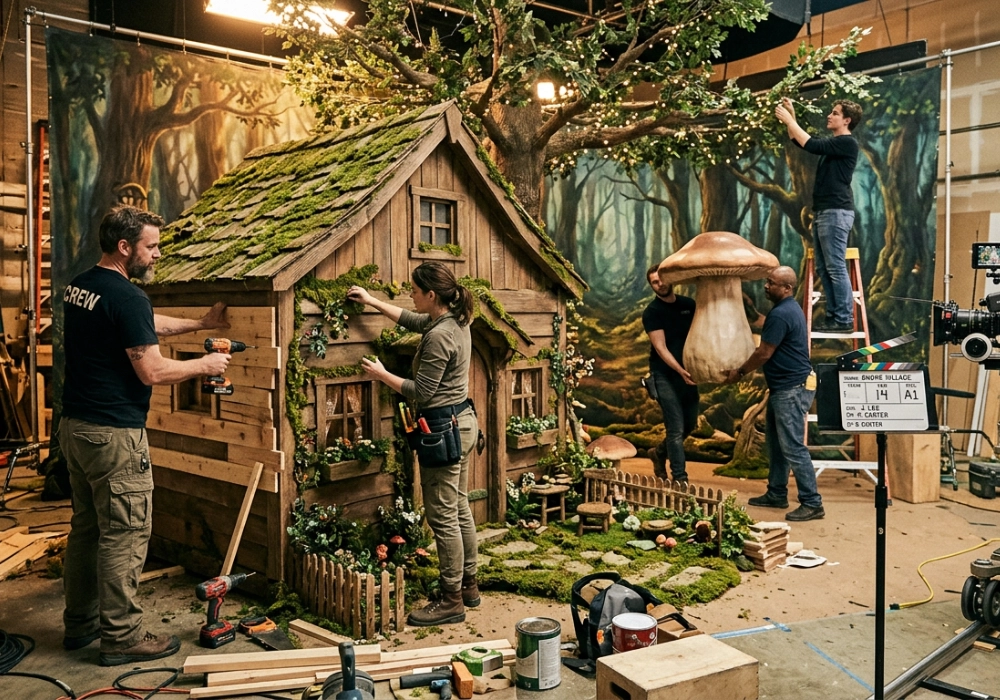
The world of a film or television production is built from details.
The architecture surrounding a character. The furniture in the room. The signage on a storefront. The decorative elements on a wall. A custom reception desk. A period-specific architectural feature. The industrial machinery in the background. Even the smallest environmental details can help establish where—and when—the story takes place.
These elements are the physical expression of the production designer’s vision.
Statement Fabrication helps turn production design concepts into tangible, camera-ready elements for film, television, commercials, branded content, and other visual productions.
From custom millwork and architectural elements to signage, furniture, specialty structures, and highly detailed environmental pieces, we fabricate the components that bring designed environments to life.
What Are Production Design Elements?
Production design encompasses the visual world of a production.
While a set provides the physical environment, production design elements are the individual components that give that environment its identity, character, period, and visual storytelling.
These can include:
- Custom architectural elements
- Millwork
- Furniture
- Doors and windows
- Signage and dimensional lettering
- Counters and reception desks
- Wall treatments
- Decorative features
- Columns and architectural details
- Retail fixtures
- Industrial elements
- Custom lighting structures
- Sculptural elements
- Themed environmental details
- Specialty fabricated objects
Some may be immediately noticeable.
Others may only appear briefly in the background.
But together, they create the visual language of the environment.
Turning Production Design Into Reality
Production designers and art departments often begin with a creative vision rather than a manufacturing plan.
That vision may arrive as concept artwork, renderings, sketches, reference photography, mood boards, technical drawings, or a combination of all of them.
The fabrication team then has to translate that vision into something physical.
What material should it be made from?
How large should it be?
How will it be constructed?
Does it need to support weight?
Will an actor interact with it?
Does it need to be removable?
How will it be transported?
How close will the camera get?
Those questions influence the fabrication process.
The goal isn’t simply to reproduce a drawing.
It’s to build the physical object the production actually needs.
Architectural Elements That Establish the World
Architecture can communicate an enormous amount of information without a character saying a word.
A doorway can establish a period.
A decorative column can communicate luxury.
A storefront can identify a location.
A futuristic wall system can establish a fictional world.
A weathered architectural feature can suggest decades of history.
Custom architectural fabrication allows production designers to control those details rather than relying exclusively on whatever is already available at a location.
Statement Fabrication can create custom architectural elements including:
- Columns and capitals
- Arches
- Doorways
- Window surrounds
- Wall panels
- Moldings
- Trim
- Cornices
- Balustrades
- Decorative screens
- Facades
- Ceiling features
- Architectural sculptures
These elements can be fabricated individually or integrated into a larger scenic environment.
Custom Millwork for Film & Television
Millwork is one of the most effective ways to make a production environment feel specific and authentic.
A custom bar.
A restaurant counter.
A reception desk.
Built-in shelving.
Cabinetry.
A retail display.
A period-specific interior.
These elements can be designed and fabricated specifically for the production rather than modified from commercially available products.
Custom millwork can also be constructed around camera requirements.
A piece may need removable sections, hidden access, specific dimensions, or unusual proportions based on the needs of the scene.
The result can look like a permanent architectural installation while being purpose-built for the production.
Furniture & Environmental Pieces
Furniture does more than fill an empty room.
It establishes character.
The furniture in a futuristic laboratory should look different from the furniture in a 1920s hotel.
A high-end corporate office communicates something different from a rundown industrial workspace.
Production designers can use furniture and environmental pieces to reinforce the story, and custom fabrication provides the freedom to create exactly what the scene requires.
Custom-fabricated pieces can include:
- Tables
- Desks
- Counters
- Seating
- Benches
- Display cases
- Shelving
- Cabinets
- Beds
- Specialty furniture
- Retail fixtures
- Hospitality elements
When a specific look or dimension can’t be found commercially, fabrication becomes the solution.
Signage & Environmental Graphics
Signage can be one of the most powerful details in a production environment.
A single sign can establish a location, identify a fictional business, reinforce a period, or communicate an entire fictional world.
Statement Fabrication can create custom dimensional signage and environmental elements using a variety of fabrication methods and materials.
These can include:
- Dimensional lettering
- Storefront signage
- Wayfinding elements
- Monument-style signs
- Architectural lettering
- Illuminated elements
- Custom logos
- Specialty signs
- Vintage-inspired signage
- Fictional brand identities
The objective isn’t simply to make a sign.
It’s to make a sign that looks like it belongs in the world of the story.
Period-Specific Production Design
Period productions place additional demands on production design.
Modern manufacturing techniques may need to reproduce the visual characteristics of an earlier era.
That can require carefully researched proportions, materials, construction details, hardware, typography, finishes, and decorative elements.
Modern fabrication technology can actually make this work more achievable.
Digital modeling allows complex historical details to be developed accurately. CNC technology can reproduce intricate shapes consistently. 3D printing can create custom decorative components. Metal fabrication and woodworking can reproduce period-specific construction.
The final piece may be fabricated using modern methods while looking like it came from another century.
Futuristic & Fantasy Production Design
The opposite challenge is equally interesting.
Instead of recreating history, the production may need to create something that doesn’t exist yet.
Futuristic interiors.
Advanced technology.
Fictional architecture.
Imaginary machines.
Fantasy environments.
Alien-inspired design elements.
These concepts often have no established construction method.
That’s where fabrication becomes an exercise in creative problem solving.
The production design establishes the visual language, and the fabrication team determines how to turn that language into physical objects and environments.
There may be no blueprint.
No catalog.
No manufacturer.
Just a concept.
That’s enough to start building.
Designing for the Camera
Production design elements need to function differently from ordinary architectural or commercial products.
A component might only be visible from one angle.
A wall feature might need to be exaggerated because of the camera distance.
A piece of furniture may need to accommodate camera equipment.
A decorative element might need to be removable between shots.
A large architectural component may need to appear solid while remaining lightweight enough to install quickly.
These considerations can influence the entire fabrication strategy.
That’s why it is valuable to involve fabrication expertise early in the design process.
The earlier construction realities are considered, the more opportunities there are to find efficient solutions.
Materials Are Part of the Design
The right material can make a major difference in both appearance and practicality.
Production design elements can incorporate:
- Wood
- Plywood
- Steel
- Aluminum
- Foam
- Fiberglass
- Plastics
- Composites
- 3D-printed materials
- Specialty coatings
- Mixed-material assemblies
A single element may combine several of these.
For example, a custom architectural feature could use a metal framework for strength, CNC-cut foam for its form, fiberglass for durability, and specialty finishing to create the appearance of aged stone.
The audience sees one finished object.
Behind the scenes, it may be the result of several fabrication disciplines working together.
CNC & Digital Fabrication
Modern production design increasingly benefits from digital fabrication.
CNC cutting can create precise architectural components, templates, panels, and sculptural forms.
Large-format cutting technology can make it practical to produce oversized elements with consistent dimensions.
Digital fabrication is especially useful when a production requires multiple matching pieces or intricate geometry.
Instead of manually reproducing each component, a digital model can become the foundation for repeatable fabrication.
That combination of digital precision and hands-on craftsmanship allows production designers to pursue more ambitious concepts.
3D Printing for Production Design
3D printing can be particularly useful for production design elements that require unusual geometry or fine detail.
Applications can include:
- Decorative architectural details
- Custom hardware
- Sculptural elements
- Specialty fixtures
- Intricate props integrated into environments
- Repeated design components
- Prototypes
- Custom signage details
- Fictional technology
Because the components originate digitally, designs can be modified and reproduced with a high degree of consistency.
For productions with unusual design requirements, this can open possibilities that would be difficult or expensive to achieve through traditional fabrication alone.
Foam Sculpting & Large-Format Elements
Large production design elements don’t necessarily need to be fabricated from heavy traditional materials.
Foam sculpting and CNC foam cutting can produce large architectural and sculptural forms while keeping the finished components comparatively lightweight.
Foam can be shaped into:
- Architectural ornament
- Stonework
- Sculptures
- Rock formations
- Decorative structures
- Oversized design elements
- Fantasy architecture
- Organic forms
After fabrication, the surface can be hardened and finished to resemble stone, concrete, wood, metal, plaster, or other materials.
This makes foam particularly useful when scale and visual impact matter but weight needs to remain manageable.
Metal Fabrication for Production Design
Metal can provide both structural integrity and visual character.
Custom metal fabrication can be used for structural frameworks, architectural details, furniture, railings, decorative elements, industrial environments, specialty fixtures, and other production design components.
Welding, tube fabrication, formed metal, laser cutting, and other techniques can be combined to create both functional and decorative pieces.
Metal can also provide the hidden structure beneath scenic materials, allowing a visually complex element to remain structurally sound.
Fiberglass & Composite Elements
Fiberglass can provide another practical solution for production design.
It allows complex forms to be fabricated with relatively lightweight, durable shells.
Fiberglass can be used for architectural components, sculptural elements, specialty furniture, decorative structures, and other custom pieces.
It can also be finished to replicate a wide variety of materials.
A fiberglass component can be made to look like cast metal, carved stone, ceramic, wood, or another material depending on the desired visual effect.
Finishing Makes the Design Believable
The fabrication process creates the object.
Finishing creates its history.
A production design element may need to look brand new—or like it has been sitting in the same location for fifty years.
A restaurant counter may need subtle wear around the edges.
A historical doorway may need layers of aging.
A fictional industrial environment may need grime, oxidation, scratches, and weathering.
A luxury environment may require an exceptionally clean and refined finish.
Scenic finishing techniques allow fabricated elements to become believable components of the production environment.
And because cameras can capture details that the human eye may overlook, finishing quality matters.
One Design Can Become an Entire System
A production environment rarely consists of one isolated design element.
A restaurant may require a complete collection of custom counters, shelving, millwork, signage, tables, architectural details, and decorative elements.
A futuristic laboratory might involve wall systems, consoles, fixtures, machinery, structural elements, and specialty components.
A retail environment may require branded fixtures, product displays, signage, counters, and architectural features.
Fabricating multiple related elements together can help maintain consistency across the environment.
The same materials, finishes, proportions, design language, and construction standards can be carried throughout the project.
Fabrication That Supports Production Schedules
Film and television schedules don’t always provide unlimited time.
Production design elements may need to move rapidly from concept to fabrication, finishing, delivery, and installation.
That makes communication and coordination critical.
Digital modeling, modern fabrication equipment, and integrated fabrication capabilities can help reduce unnecessary handoffs between vendors.
At Statement Fabrication, multiple fabrication disciplines can work together within the same operation, helping streamline complex projects that might otherwise require several specialized suppliers.
The result is a more coordinated path from design intent to finished production element.
Built for the World of the Story
The best production design elements don’t look like fabrication.
They look like they belong.
A storefront feels like a real storefront.
A desk feels like it has always been in the office.
A piece of architecture looks as though it was built decades ago.
A futuristic console looks like it came from a world that doesn’t exist yet.
That is the goal.
The fabrication should disappear into the story.
Bringing Production Design to Life
At Statement Fabrication, we understand that production design is about much more than individual objects.
It’s about creating a believable world.
Our Las Vegas fabrication facility combines 3D modeling and design, CNC cutting, 3D printing, metal fabrication, carpentry and millwork, foam sculpting, fiberglass fabrication, and specialty finishing to turn production design concepts into physical reality.
Whether you’re fabricating one highly detailed architectural feature or hundreds of interconnected environmental elements, we can help determine the right combination of materials, technology, and craftsmanship to bring the design to life.
Your Design. Our Fabrication.
Production designers imagine the world.
Fabricators help make it real.
At Statement Fabrication, we specialize in the part between “What if?” and “There it is.”
From custom architectural elements and millwork to signage, furniture, specialty structures, and one-of-a-kind environmental details, we build production design elements that are designed to look right, function properly, and perform when the camera rolls.
Have a production design concept that needs to become physical?
Bring us the drawings, renderings, sketches—or simply the idea.
We’ll help build the world.