


Every successful aerospace product starts with a question.
Will it fit?
Will it perform?
Can it be manufactured efficiently?
Can it withstand real-world operating conditions?
The answers rarely come from a computer model alone.
They come from prototypes.
At Statement Fabrication, we specialize in aerospace prototype development and testing support, helping engineering teams transform concepts into physical components, assemblies, tooling, fixtures, and test articles that accelerate development while reducing risk.
Because in aerospace, discovering problems early is significantly less expensive than discovering them after production begins.
Why Prototyping Is Critical in Aerospace
Modern aerospace systems are incredibly sophisticated.
Aircraft components, satellite systems, ground support equipment, structural assemblies, and aerospace technologies all require extensive validation before they move into production.
Prototype development allows engineering teams to evaluate:
- Form and fit
- Functionality
- Manufacturability
- Assembly requirements
- Material selection
- Structural performance
- Integration challenges
- Production readiness
The aerospace industry relies heavily on prototyping because physical testing helps identify design challenges early, before significant investments are made in production tooling, manufacturing, procurement, and qualification activities.
Simply put:
A prototype reduces uncertainty.
From Digital Design to Physical Reality
Every prototype begins with an idea.
That idea may exist as:
- A CAD model
- An engineering drawing
- A concept sketch
- A simulation
- A new product concept
- A revised design iteration
The challenge is turning that digital concept into something engineers can physically evaluate.
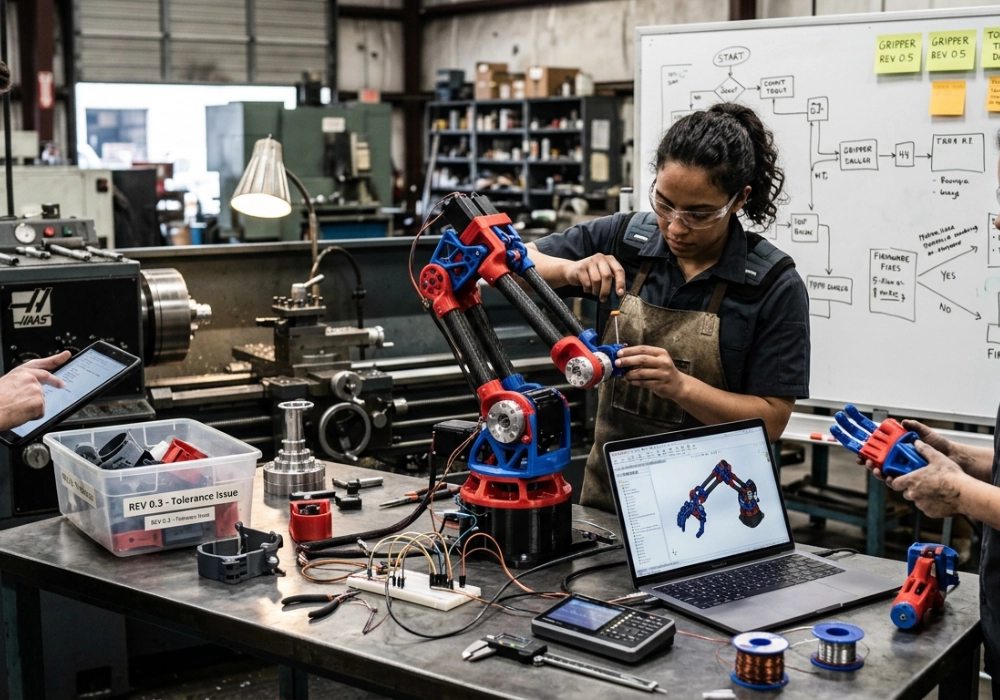
Statement Fabrication combines advanced fabrication technologies, 3D modeling, large-format 3D printing, CNC manufacturing, metal fabrication, composite fabrication, and engineering-focused production processes to create physical prototypes that provide meaningful development data.
Because a prototype isn’t just a model.
It’s a learning tool.
What Aerospace Prototypes Are Designed to Validate
Not all prototypes serve the same purpose.
Some answer design questions.
Others answer manufacturing questions.
The most effective prototype programs begin with a clearly defined objective. Aerospace development teams frequently use prototypes to validate geometry, interfaces, functionality, manufacturability, material selection, and production feasibility before committing to larger manufacturing decisions.
Common prototype objectives include:
Form Validation
Does the part physically match the intended design?
Fit Validation
Will the component integrate properly with adjacent systems and assemblies?
Functional Testing
Does the design perform as expected under operating conditions?
Manufacturing Validation
Can the component be produced efficiently and consistently?
Assembly Validation
Will technicians be able to install and service the component effectively?
Material Evaluation
Is the selected material appropriate for the application?
The earlier these questions are answered, the fewer surprises occur later in development.
Accelerating Development Through Rapid Prototyping
Speed matters in aerospace development.
Engineering teams are constantly balancing innovation, performance, budget, and schedule requirements.
Rapid prototyping helps move projects forward by providing physical parts quickly enough to support iterative development cycles.
Instead of waiting for production tooling or long manufacturing lead times, engineers can evaluate designs sooner, make improvements, and move forward with greater confidence. Rapid prototyping has become increasingly valuable because it enables faster design validation, earlier problem identification, and more efficient development cycles.
The goal isn’t simply to build parts faster.
The goal is to learn faster.
Large-Format 3D Printing for Aerospace Development
Additive manufacturing has become one of the most powerful tools available during aerospace development.
Large-format 3D printing allows teams to rapidly produce:
- Prototype components
- Mockups
- Assembly models
- Functional test parts
- Tooling
- Fixtures
- Ergonomic evaluations
- Concept verification models
Because additive manufacturing doesn’t require traditional tooling, design changes can often be incorporated quickly and cost-effectively.
NASA and aerospace manufacturers continue expanding additive manufacturing adoption because it reduces development timelines while enabling complex geometries and rapid iteration.
Prototype Tooling & Test Fixtures
Not every aerospace prototype is a flight component.
Many development programs require specialized tooling to support testing and evaluation.
Statement Fabrication can support the production of:
- Test fixtures
- Assembly fixtures
- Inspection fixtures
- Positioning systems
- Prototype tooling
- Mockup structures
- Demonstration models
- Manufacturing aids
These supporting systems often play a critical role in collecting meaningful testing data and improving development efficiency.
Engineering Through Iteration
One of the greatest advantages of prototype-driven development is the ability to learn through iteration.
Very few complex aerospace products are perfected in a single design cycle.
Instead, engineering teams often move through multiple prototype generations.
Each iteration provides new information:
- Dimensional feedback
- Assembly feedback
- Performance feedback
- Manufacturing feedback
- User feedback
Those insights can then be incorporated into the next version.
This iterative approach has become a cornerstone of modern aerospace development because it reduces risk while improving final product quality.
Testing Before Production
A prototype only becomes valuable when it is tested.
Testing programs may vary significantly depending on the project, but common objectives often include:
- Dimensional verification
- Structural evaluation
- Functional validation
- Assembly verification
- Environmental testing support
- Manufacturing assessments
- Material evaluations
The purpose of testing is not merely to confirm success.
Testing is equally valuable when it identifies weaknesses that can be corrected before production begins.
Finding a problem during prototype testing is often a win.
Finding the same problem after production starts is considerably more expensive.
Design for Manufacturability
A design that performs well still needs to be manufacturable.
Prototype development provides an opportunity to evaluate manufacturing processes before production commitments are made.
This can help identify:
- Difficult geometries
- Material challenges
- Tolerance concerns
- Assembly inefficiencies
- Inspection limitations
- Production bottlenecks
Aerospace organizations increasingly use prototype programs to evaluate manufacturability early in development because production feasibility is just as important as design performance.
Qualification & Validation Considerations
Aerospace products often require rigorous qualification processes before entering service.
While qualification requirements vary depending on the application, prototype development frequently plays a key role in generating the data necessary to support validation and qualification efforts.
Testing can help establish confidence in:
- Materials
- Processes
- Manufacturing methods
- Geometries
- Assembly procedures
- Performance expectations
Qualification programs for aerospace components frequently require extensive testing, documentation, inspection, and process validation before approval for critical applications.
Complex Geometries & Advanced Manufacturing
Modern aerospace designs continue pushing the boundaries of what’s possible.
Complex internal structures, lightweight components, optimized geometries, and advanced assemblies are becoming increasingly common.
Prototype development allows engineers to evaluate these designs before committing to production.
Advanced manufacturing technologies make it possible to produce:
- Complex shapes
- Lightweight structures
- Integrated assemblies
- Topology-optimized designs
- Advanced tooling
- Specialized fixtures
Additive manufacturing in particular has expanded opportunities for testing complex aerospace designs that would be difficult or expensive to evaluate using traditional manufacturing methods.
Bridging the Gap Between Engineering and Production
One of the most valuable functions of prototype development is creating a bridge between design and manufacturing.
A successful prototype program can help answer critical questions before production begins:
- Can the part be manufactured efficiently?
- Can it be inspected?
- Can it be assembled?
- Can it be repeated consistently?
- Can it meet performance requirements?
The answers to these questions reduce uncertainty and improve decision-making throughout the development process.
Prototype Development for Aerospace Suppliers & Contractors
Prototype development isn’t limited to aircraft manufacturers.
Many organizations throughout the aerospace supply chain benefit from rapid prototyping and testing support.
This includes:
- Aerospace manufacturers
- Defense contractors
- Satellite developers
- Space technology companies
- Research organizations
- Engineering firms
- Government programs
- Ground support equipment providers
Whether developing a new product or refining an existing design, physical prototypes remain one of the most effective tools available to engineers.
Aerospace Prototype Development in Las Vegas
Southern Nevada continues to attract growth in aerospace, defense, advanced manufacturing, and technology sectors.
Statement Fabrication supports these industries with advanced manufacturing capabilities including:
- 3D Modeling & Design
- Large-Format 3D Printing
- CNC Cutting & Processing
- Metal Fabrication
- Fiberglass Fabrication
- Prototype Tooling
- Engineering Support
- Product Development Assistance
- Specialty Manufacturing
Our ability to combine multiple manufacturing disciplines under one roof allows development teams to move efficiently from concept through prototype and into production planning.
Build, Test, Improve, Repeat
The aerospace industry has always been driven by innovation.
But innovation doesn’t happen through assumptions.
It happens through testing.
Through validation.
Through iteration.
And through the willingness to turn ideas into physical reality.
Statement Fabrication helps aerospace organizations accelerate development through prototype fabrication, testing support, manufacturing validation, and advanced production capabilities.
If your next aerospace project requires a prototype partner capable of combining technology, craftsmanship, and precision execution, we’re ready to help.
Because the best aerospace products aren’t guessed into existence.
They’re tested into existence.
We Build Statements.