


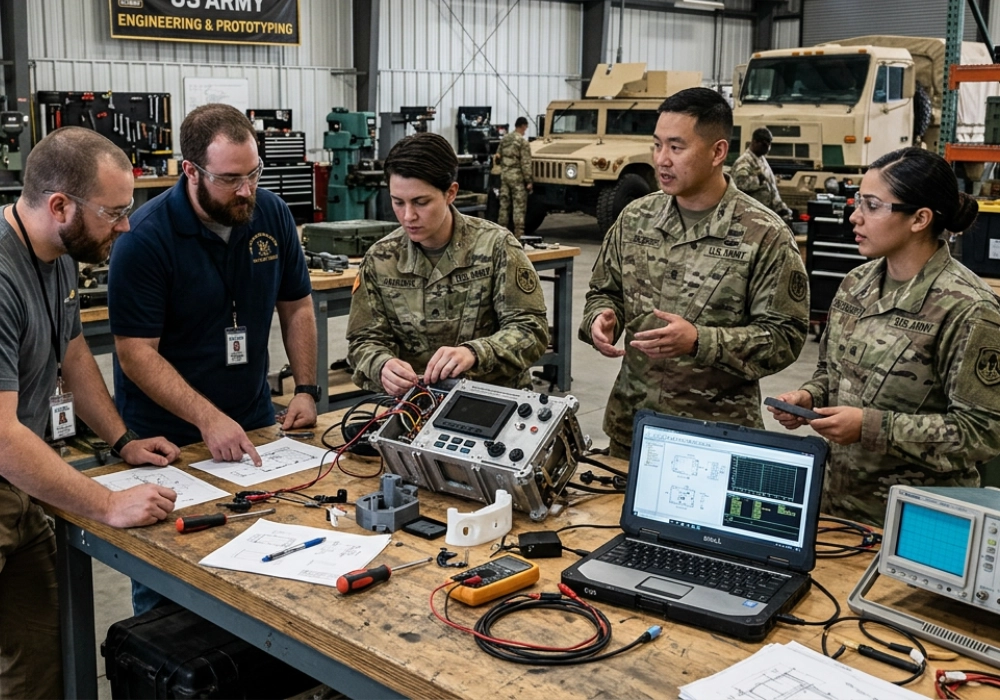
Military and defense projects often begin with a problem that doesn’t have an off-the-shelf solution.
A new piece of equipment may need a custom component. An engineering team may need to evaluate a new design in the physical world. A defense contractor may need a full-scale mockup before moving into production. A training program may require a realistic physical prototype. Or an existing component may need to be redesigned, modified, or manufactured using a different process.
In each case, the ability to move quickly from concept to physical prototype can be extremely valuable.
Statement Fabrication provides rapid prototyping and development support for military applications, defense contractors, government organizations, training environments, and specialized research and development projects.
Our combination of 3D modeling, large-format 3D printing, CNC fabrication, metal fabrication, fiberglass, foam sculpting, and other advanced manufacturing capabilities allows us to help turn digital concepts into physical prototypes and development models.
Why Rapid Prototyping Matters in Military Applications
Prototyping provides a way to evaluate an idea in physical form before committing to a larger production effort.
The U.S. Department of Defense has specifically incorporated rapid prototyping into its acquisition framework, including a Middle Tier of Acquisition pathway intended to accelerate development of fieldable prototypes and new capabilities.
For fabrication teams, the principle is straightforward: build something, evaluate it, learn from it, improve it, and build again.
A digital model can communicate dimensions and geometry, but a physical prototype can reveal things that are difficult to fully understand on a screen.
Physical prototyping can help teams evaluate:
- Form and overall geometry
- Component fit
- Physical interfaces
- Ergonomics and accessibility
- Assembly concepts
- Scale and proportions
- Equipment clearances
- Access and serviceability
- Manufacturing approaches
- Material choices
- Weight and handling considerations
- Tooling and fixture concepts
- Integration with surrounding components
The prototype becomes a tangible part of the development process.
From Concept to Physical Prototype
Rapid prototyping doesn’t necessarily start with a finished CAD model.
A project may begin with a sketch, reference component, physical part, concept drawing, CAD file, engineering documentation, or simply a description of what the component needs to accomplish.
Statement Fabrication can support the fabrication side of the development process by translating available project information into physical prototypes and fabricated development components.
A typical workflow may look like:
Concept → 3D Modeling → Prototype Fabrication → Physical Evaluation → Revision → Second Prototype → Final Fabrication Approach
The exact process depends on the project and the stage of development.
The important part is maintaining a practical connection between the digital design and the physical object.
3D Printing for Military Prototyping
Large-format 3D printing is one of the most useful tools in a rapid-development environment.
Military organizations themselves are increasingly using additive manufacturing for rapid prototyping, form/fit/function evaluation, tooling, and specialized components. For example, the U.S. Army’s Tobyhanna Army Depot identifies rapid prototyping, manufacturing aids, custom tooling, and form/fit/function prototypes among its additive manufacturing applications.
Statement Fabrication can use large-format 3D printing to produce physical prototypes quickly without immediately committing to traditional tooling or more labor-intensive fabrication methods.
Potential applications include:
- Concept models
- Full-scale prototypes
- Component prototypes
- Equipment housings
- Custom enclosures
- Fixtures and tooling concepts
- Form-and-fit studies
- Ergonomic models
- Large physical mockups
- Architectural or equipment interfaces
- Complex geometric components
For certain projects, 3D printing can also provide a bridge between prototyping and other manufacturing processes.
A printed prototype may ultimately become a master pattern, mold form, tooling component, or reference for a different production process.
Form, Fit & Function Prototypes
A prototype doesn’t always need to be a final-production part.
Sometimes the most valuable prototype is one that answers a specific question.
Does it fit?
Is the geometry correct?
Can someone physically interact with it?
Does the equipment interface work as intended?
Is there enough clearance?
Can the components be assembled in the proposed configuration?
Is the overall scale correct?
These questions can often be answered much faster with a physical model.
Statement Fabrication can produce prototypes intended specifically for this type of evaluation, including form, fit, and physical-interface studies.
This approach can allow design teams to identify issues earlier—before investing heavily in production tooling, materials, or larger manufacturing runs.
Rapid Iteration Is the Real Advantage
The greatest value of rapid prototyping isn’t necessarily producing one prototype quickly.
It’s being able to iterate.
A first prototype may reveal that a component needs to be larger. A mounting point may need to move. An enclosure may need additional clearance. A particular shape may be difficult to fabricate using the originally intended process.
The design can be modified and another physical version produced.
That creates a development loop:
Design → Build → Evaluate → Modify → Build Again
The U.S. Army has described similar additive-manufacturing workflows in which prototypes are produced, evaluated against design criteria, redesigned, and reproduced.
For specialized military and defense projects, that ability to physically iterate can be far more valuable than simply producing a one-time model.
Prototyping Beyond 3D Printing
Although 3D printing is an important part of rapid prototyping, it is not the only tool available.
Different prototypes require different fabrication methods.
Statement Fabrication can combine multiple processes depending on the requirements of the project.
Metal Fabrication
Metal prototypes can be fabricated when the physical characteristics of metal are important to the evaluation.
This can include custom brackets, frames, housings, supports, platforms, assemblies, and other fabricated components.
CNC & Laser Cutting
Digital cutting processes can rapidly produce precise flat components, panels, brackets, templates, and other parts that can be incorporated into a prototype assembly.
Fiberglass & Composite Fabrication
For prototypes requiring complex contours, lightweight forms, or composite construction, fiberglass fabrication can provide another path from digital model to physical component.
Foam Prototyping
Large-format foam cutting and sculpting can be particularly useful for quickly producing oversized forms, ergonomic studies, physical mockups, tooling patterns, and other large-scale prototypes.
Custom Fabrication
Some development projects simply require a combination of processes.
A prototype may include welded metal components, CNC-cut panels, 3D-printed parts, fiberglass elements, foam forms, and custom-fabricated details—all assembled into one physical development model.
That is where having multiple fabrication capabilities available through one shop becomes especially valuable.
Prototyping for Defense Contractors
Statement Fabrication can support defense contractors and other organizations that need an experienced fabrication resource during development.
A contractor may already have an engineering team, product-development group, or systems integrator working on a project but require specialized fabrication capabilities to produce physical prototypes.
We can support that process by fabricating:
- Engineering prototypes
- Concept demonstrators
- Full-scale mockups
- Equipment prototypes
- Custom housings and enclosures
- Physical interface models
- Prototype assemblies
- Tooling and fixtures
- Manufacturing aids
- Training prototypes
- Large-format development models
This can allow the contractor’s engineering and development teams to focus on their core work while Statement Fabrication handles the physical fabrication side of the prototype.
Rapid Prototyping for Training & Simulation
Physical prototypes can also play an important role in military training and simulation.
A training environment may require a physical representation of equipment, a custom interface, a realistic component, or a full-scale mockup to create a useful training experience.
Statement Fabrication can fabricate physical training assets ranging from individual components to larger structures and environments.
Potential applications include:
- Equipment training mockups
- Interface prototypes
- Full-scale equipment replicas
- Training fixtures
- Physical simulation components
- Environmental mockups
- Large-scale models
- Custom training props
- Demonstration units
The goal is to provide a physical representation appropriate to the training or development objective—not necessarily to reproduce every aspect of an operational system.
Reverse Engineering & Existing Components
Rapid development can also begin with something that already exists.
An existing component may need to be reproduced, modified, redesigned, or adapted because of obsolescence, availability, design changes, or a new application.
Depending on the project, digital modeling and fabrication can help translate an existing physical form into a new digital or fabricated component.
The U.S. Army has identified additive manufacturing and digital modeling as tools for addressing difficult-to-source and obsolete components as well as supporting rapid prototyping.
Statement Fabrication can support the physical fabrication and prototyping portion of these efforts based on the documentation, models, measurements, and requirements provided by the project team.
Prototyping Large-Scale Components
Not every prototype is small.
Military development projects can involve large equipment, specialized structures, facility interfaces, training environments, and other components where scale matters.
Statement Fabrication’s large-format fabrication capabilities make it possible to approach prototyping at substantially larger scales than conventional desktop prototyping.
Large-format 3D printing, CNC foam cutting, metal fabrication, fiberglass, millwork, and other processes can be combined to create oversized prototypes and development models.
That can be especially useful when the prototype needs to be physically evaluated by multiple people or incorporated into a larger environment.
From Prototype to Production
A prototype should ideally do more than demonstrate an idea.
It can also help inform how that idea will eventually be manufactured.
During development, the fabrication process itself can reveal opportunities to:
- Reduce unnecessary components
- Simplify assembly
- Change materials
- Consolidate parts
- Improve repeatability
- Modify joining methods
- Reduce fabrication complexity
- Identify tooling requirements
- Select an appropriate production process
This is one reason Statement Fabrication approaches prototyping as part of a broader fabrication workflow rather than treating it as an isolated 3D-printing service.
The prototype can become an important step toward a practical manufacturing solution.
A Flexible Fabrication Partner for Military Development
Rapid development requires flexibility.
Different projects require different materials, technologies, scales, and fabrication approaches. A process that makes sense for a small prototype may not make sense for a full-scale component. A shape that is easy to 3D print may ultimately be better suited to fiberglass, metal, CNC fabrication, or another production method.
Statement Fabrication brings multiple fabrication disciplines together in one Las Vegas facility, allowing our team to approach each prototype according to its specific requirements.
Our capabilities include:
- 3D Modeling & Design
- Large-Format 3D Printing
- Metal Fabrication
- CNC & Laser Cutting
- Fiberglass Fabrication
- Foam Sculpting & CNC Foam Cutting
- Carpentry & Custom Millwork
- Custom Assembly
- Specialty Fabrication
That combination provides a practical advantage when a prototype doesn’t fit neatly into one manufacturing category.
Military Rapid Prototyping in Las Vegas
Statement Fabrication is a full-service fabrication shop in Las Vegas supporting military, defense, government, aerospace, and commercial projects.
Our role in a development project is straightforward: help turn the approved design into a physical object that can be evaluated, refined, and ultimately fabricated using an appropriate production approach.
Whether you need a small prototype component, a full-scale mockup, a specialized assembly, or a complex multi-material development model, we can bring advanced fabrication technology and experienced craftsmanship to the project.
Build the Prototype. Learn From It. Build It Better.
The path from concept to finished product is rarely perfectly linear.
The best development process leaves room to test ideas, discover problems, make improvements, and try again.
Statement Fabrication provides the fabrication capabilities to support that process—from digital modeling and large-format 3D printing to CNC cutting, metal fabrication, fiberglass, foam, millwork, and custom assembly.
When military and defense projects need to move an idea from the screen into the real world, Statement Fabrication helps build the next iteration.
Have a military prototype or development project? Contact Statement Fabrication to discuss your requirements and request a quote.
Prototype fabrication is performed according to project-specific drawings, specifications, and approved requirements. Testing, engineering certification, qualification, compliance, and final production approval remain dependent on the specific project and responsible design authorities.