


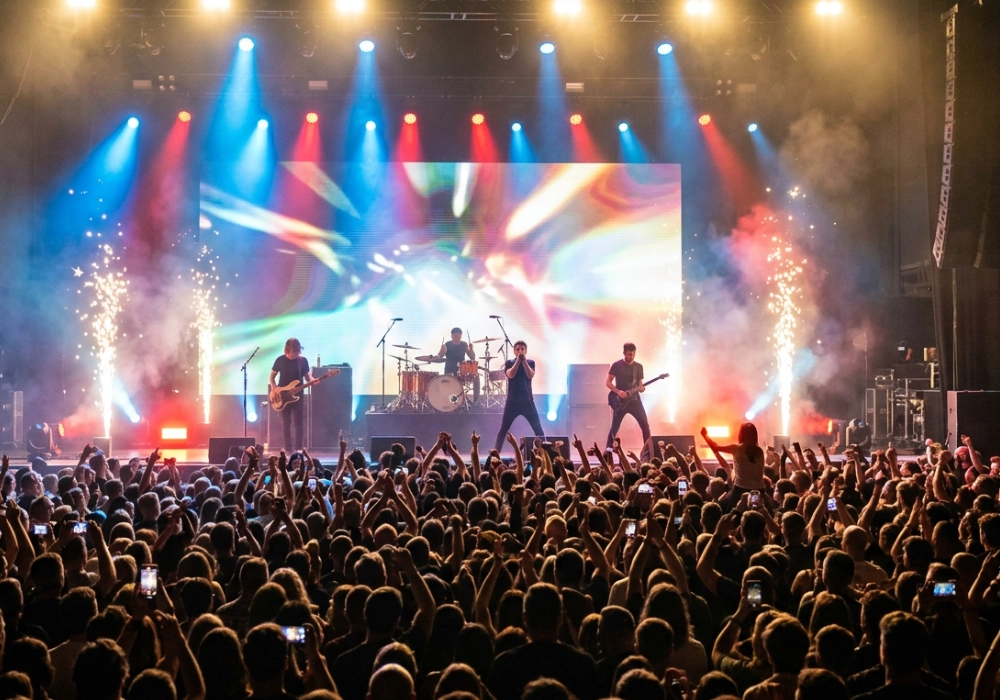
A stage is where the performance happens.
But the environment surrounding that performance is what can turn a stage into an experience.
A massive architectural backdrop. A sculptural centerpiece. A custom DJ booth. Elevated performance platforms. Dramatic portals. Oversized scenic structures. Artist-specific stage elements. A complete environment built around the identity of a show.
These elements establish scale, atmosphere, and visual identity before the performer even walks onstage.
At Statement Fabrication, we build custom stage and performance environments for concerts, festivals, touring productions, corporate events, ceremonies, branded experiences, and live entertainment.
We take creative concepts and turn them into physical environments designed to look exceptional, function within the production, and make an impact from the audience’s first view to the final cue.
More Than a Stage
A traditional stage provides the platform.
A custom performance environment provides the world around the performance.
That distinction matters.
Today’s live productions can incorporate massive LED displays, lighting systems, video content, special effects, performers, dancers, musicians, brand elements, scenic structures, and interactive experiences into one coordinated visual presentation. The physical stage environment needs to complement all of those elements rather than compete with them.
Custom fabrication gives producers and creative teams the freedom to build the environment around the show instead of forcing the show to fit a standard stage configuration.
That can mean creating a stage that feels:
- Futuristic
- Industrial
- Architectural
- Luxurious
- Surreal
- Minimalist
- Theatrical
- Organic
- Branded
- Monumental
- Completely original
If the concept calls for it, the stage can become part of the story.
What Is a Performance Environment?
A performance environment is the physical setting surrounding and supporting a live performance.
It can range from a few custom scenic elements to a complete fabricated stage environment.
Examples include:
- Custom stage facades
- Scenic backdrops
- Performance platforms
- Artist risers
- DJ booths
- Scenic towers
- Portals and arches
- Architectural structures
- Sculptural elements
- Stage wings
- Branded stage elements
- Custom stairs and platforms
- Oversized props
- Interactive scenic pieces
- Themed environments
- Performer-specific set pieces
The right combination depends on the production.
A touring artist may need a modular environment designed to travel from city to city. A festival may require a massive one-of-a-kind stage centerpiece. A corporate event may need a sophisticated stage environment built around a keynote, product launch, or awards program.
The fabrication strategy starts with understanding the experience.
Designing the Environment Around the Performance
A stage isn’t experienced from a single viewpoint.
There may be thousands of people in the audience.
There may be cameras capturing the performance for broadcast or social media.
There may be VIP areas with completely different sightlines.
Lighting and video may change the appearance of the environment throughout the show.
That means stage fabrication needs to consider more than what something looks like in a rendering.
Where will the audience see it from?
Where will the cameras be positioned?
How will lighting interact with the surfaces?
Where do performers need to move?
Where does technical equipment need to go?
How will the scenic elements coexist with LED and video systems?
These considerations help determine the dimensions, materials, geometry, finishes, and construction methods of the finished environment. Stage environments often have to function simultaneously for audiences, cameras, lighting, video, performers, and production crews.
From Concept to Show-Ready Environment
Most custom performance environments begin with an idea.
That idea might be a hand sketch, concept rendering, 3D visualization, creative brief, stage plot, or complete production design package.
From there, the concept needs to become buildable.
A typical fabrication workflow can look something like:
Concept → 3D Modeling → Engineering & Planning → Fabrication → Finishing → Assembly → Installation
Each stage answers different questions.
How big should it be?
What materials should be used?
How does it break down?
How does it transport?
How will it assemble?
How will performers interact with it?
How will it integrate with the larger production?
The goal is to turn a creative vision into something that can actually exist in a live environment.
Custom Stage Architecture
Architecture can completely change the character of a performance space.
Large-scale columns, portals, arches, facades, geometric structures, towers, and other architectural elements can frame the performer and create a powerful sense of scale.
These structures can be inspired by virtually anything.
A futuristic city.
An ancient temple.
An industrial facility.
A luxury interior.
A geometric sculpture.
A fictional world.
Or something that has never existed before.
Modern fabrication techniques make it possible to build architectural forms specifically around the dimensions, aesthetics, and requirements of a production.
Scenic Structures That Become Part of the Show
The strongest stage environments don’t simply sit behind the performers.
They become part of the performance.
A platform can change how an artist enters the stage.
A sculptural centerpiece can become the visual signature of a concert.
A portal can frame a performer.
A series of towers can create depth and scale.
An elevated platform can create new performance levels.
A large scenic structure can become a canvas for lighting and video.
The fabrication should support the creative direction rather than simply fill empty space.
Custom Performance Platforms & Risers
Performers don’t always need to remain on a single level.
Custom platforms and risers can create multiple performance elevations and give directors, choreographers, and artists more ways to use the stage.
These can be designed around:
- Musicians
- Dancers
- DJs
- Speakers
- Presenters
- Bands
- Featured performers
- Special guests
- Interactive performances
Platforms can also become significant visual elements in their own right.
Geometry, finishes, fascia, architectural details, and lighting integration can transform a functional platform into an important part of the overall stage design.
Artist-Specific Stage Environments
Every artist has a visual identity.
Some are immediately recognizable through color, typography, symbols, architecture, imagery, or a particular aesthetic.
A custom performance environment can bring that identity into the physical space.
Instead of simply displaying a logo, the stage itself can communicate the artist’s brand.
That could mean an environment inspired by an album’s artwork, a recurring visual theme, a particular architectural style, or an entirely new creative direction developed specifically for a tour or performance.
The result is a stage that feels owned by the artist rather than rented for the occasion.
Touring Performance Environments
Touring productions introduce another layer of complexity.
A stage environment that looks incredible in one venue may need to be transported, unloaded, assembled, operated, disassembled, and transported again—sometimes repeatedly.
That means fabrication needs to consider the road from the beginning.
Components may need to:
- Break down into transportable sections
- Fit standardized transportation requirements
- Assemble efficiently
- Withstand repeated handling
- Maintain consistent alignment
- Be durable enough for multiple shows
- Store efficiently between performances
Tour-ready fabrication is therefore about more than making something visually impressive.
It is about making something that can survive the journey.
Large-Scale Festival Stage Environments
Festivals create an opportunity to think much bigger.
A festival stage may become an architectural landmark within the event.
Thousands of attendees may see it from a distance, while others experience it from directly in front of the performance area.
The environment may need to compete visually with multiple stages, large video displays, lighting systems, branding, and the surrounding festival grounds.
Large-scale scenic fabrication can create the distinctive structures that make one stage immediately recognizable from another.
Statement Fabrication has experience working at this scale, including the fabrication of the EDC main stage, where the physical environment had to support a major live production while delivering a massive visual impact.
Corporate Performance Environments
Performance environments aren’t limited to music.
Corporate events, conferences, award shows, product launches, ceremonies, and presentations can all benefit from custom stage fabrication.
A corporate stage might incorporate:
- Branded architectural elements
- Custom podiums
- Presentation platforms
- Scenic walls
- Product display structures
- Dimensional logos
- Decorative architectural features
- Custom stage facades
- Specialty structures
The aesthetic can range from highly sophisticated and architectural to bold, futuristic, or experiential.
The physical environment becomes part of how the organization presents itself to the audience.
Integrating LED & Technology Into the Environment
Technology has become a major part of modern live performance.
Large LED screens, video walls, lighting, projection, and other technologies can dramatically change how audiences experience a stage.
But the technology still needs a physical environment around it.
Custom fabrication can create the architectural framework, fascia, portals, towers, platforms, and scenic elements that integrate technology into a cohesive visual design.
Instead of a video screen simply being placed on a stage, the fabricated environment can make the screen feel like an intentional part of the architecture.
The result is a more unified visual experience.
Materials for Performance Environments
There isn’t one material that works for every stage.
The right material depends on scale, appearance, weight, durability, transportation, installation, and the desired finish.
Custom performance environments may incorporate:
- Steel
- Aluminum
- Wood
- Plywood
- Foam
- Fiberglass
- Plastics
- Composites
- 3D-printed components
- Specialty scenic materials
Often, several materials are combined within one structure.
A metal framework might provide strength.
CNC-cut foam might create the sculptural form.
Fiberglass might provide a durable exterior.
3D-printed components might create intricate details.
Specialty finishing might make the entire structure look like stone, metal, concrete, or something entirely fictional.
The audience sees one environment.
Behind it is a carefully coordinated fabrication strategy.
CNC & Digital Fabrication
Modern digital fabrication gives stage designers new ways to create complex forms.
CNC cutting can produce precise components from digital models, while large-format cutting technology can make it possible to create substantial scenic elements with consistent dimensions.
This is particularly valuable when a stage contains repeated geometric elements or highly complex shapes.
A digital model can also help fabrication teams understand how large components will fit together before production begins.
That combination of digital precision and physical craftsmanship allows creative teams to push stage design further.
Foam Sculpting for Large-Scale Stage Elements
Large scenic forms don’t always need to be heavy.
CNC and robotic foam cutting can produce enormous sculptural elements while keeping them comparatively lightweight.
This makes foam particularly useful for:
- Oversized stage sculptures
- Architectural forms
- Rockwork
- Organic shapes
- Themed environments
- Fantasy structures
- Decorative elements
- Large-scale props
After sculpting, the surface can be hardened and finished to resemble stone, concrete, metal, wood, or virtually any other material.
The result can look massive from the audience while remaining practical to fabricate and transport.
Metal Fabrication & Structural Components
Behind many impressive stage environments is a structure that audiences never see.
Metal fabrication can provide the framework needed to support scenic elements, platforms, architectural features, and other fabricated components.
Custom welded frames, tube structures, brackets, supports, and formed metal components can be integrated into the environment as required.
The visible scenic treatment creates the experience.
The underlying fabrication makes the experience possible.
For live events, structural and installation requirements need to be addressed as part of the overall production plan, not treated as an afterthought. Industry stagehand guidance and professional standards emphasize safe handling, structural systems, and proper installation practices for live-event environments.
The Finish Has to Perform Under Lights
A stage environment can look completely different under production lighting.
Glossy surfaces reflect.
Matte surfaces absorb.
Textures create shadows.
Metallic finishes react dramatically to moving light.
Bright colors may appear differently under different lighting temperatures.
That means scenic finishing isn’t simply about how something looks in the fabrication shop.
It needs to look right onstage.
Paint, coatings, textures, aging, distressing, and specialty finishes can all be selected with the lighting environment and desired visual effect in mind.
Built for the Realities of Live Events
A live event doesn’t get a second take.
Once doors open, the environment needs to be where it belongs, assembled correctly, and ready for the show.
That makes fabrication planning especially important.
Custom stage environments need to account for:
- Venue access
- Load-in schedules
- Transportation
- Component sizes
- Assembly sequence
- Performer access
- Audience sightlines
- Technical equipment
- Rigging and structural coordination
- Installation and strike
- Storage or reuse
The creative vision is important.
But so is getting that vision into the venue on time.
The Difference Between a Stage and an Experience
A standard stage provides a place to perform.
A custom performance environment gives the audience something to remember.
It can establish the identity of a concert before the first note.
It can transform a corporate presentation into an immersive brand experience.
It can make a festival stage recognizable from across the grounds.
It can give an artist a physical world that exists only for their performance.
That’s the power of custom stage fabrication.
Built in Las Vegas. Designed to Make an Impact.
Statement Fabrication is a full-service fabrication shop in Las Vegas capable of tackling ambitious stage and performance environments at significant scale.
Our capabilities include 3D modeling and design, CNC cutting, metal fabrication, carpentry and millwork, foam sculpting, fiberglass fabrication, 3D printing, and specialty finishing.
That combination allows creative teams and event producers to move from concept to fabrication through a coordinated process rather than piecing together unrelated fabrication disciplines.
We’ve built for concerts, festivals, branded experiences, and large-scale live events—and we understand that the finished environment has to be more than impressive in a rendering.
It has to work in the real world.
Build the Stage Around the Moment
The best performance environments don’t simply frame the show.
They become part of it.
They create scale.
They create atmosphere.
They give performers a world to inhabit.
They give audiences something to remember.
And they turn a performance into an experience.
At Statement Fabrication, we build the physical environments that make those moments possible.
Have a stage concept that needs to become real?
Bring us the vision.
We’ll build the statement.