


A production can have a great story, talented performers, and a beautifully written script—but the world surrounding that story is what makes the audience believe it.
A weathered European street. A futuristic laboratory. An elaborate nightclub. A fantastical landscape. An ancient temple. A luxury resort. A fictional cityscape.
Scenic fabrication turns those creative visions into physical environments.
At Statement Fabrication, we create custom scenic environments and large-scale fabricated elements for film, television, commercials, branded productions, live entertainment, and other projects where the environment itself plays a critical role in the visual experience.
From individual architectural elements to immersive environments spanning thousands of square feet, we combine fabrication technology, engineering, craftsmanship, and specialized finishing to build environments designed for the camera.
What Is Scenic Fabrication?
Scenic fabrication is the process of physically creating the environments, architectural elements, structures, surfaces, and visual components that establish the setting of a production.
It can include everything from a single scenic wall or architectural feature to an entire fabricated environment.
Unlike conventional construction, scenic fabrication is often driven by visual storytelling rather than permanent architecture.
A scenic environment may need to look like stone without weighing as much as stone. A wall may need to resemble a century-old building while being fabricated in a matter of weeks. A massive architectural feature may need to appear monumental on camera while remaining lightweight enough to transport and install.
The goal is to create the illusion convincingly—and engineer the fabrication intelligently.
Creating Worlds That Don’t Exist
One of the most exciting aspects of scenic fabrication is that there are very few creative limitations.
Production designers and creative teams aren’t restricted to what can be found in the real world.
They can invent it.
Statement Fabrication can help turn those concepts into physical environments including:
- Fantasy worlds
- Futuristic environments
- Period settings
- Fictional architecture
- Themed environments
- Industrial environments
- Commercial interiors
- Restaurants and hospitality environments
- Nightclubs and entertainment spaces
- Streetscapes and facades
- Architectural replicas
- Large-scale scenic installations
- Immersive environments
- Sculptural landscapes
The fabrication challenge is figuring out how to make the impossible look completely believable.
From Production Design to Physical Environment
Scenic fabrication begins long before materials enter the shop.
The process often starts with concept artwork, production design drawings, renderings, reference imagery, models, or a creative direction.
From there, the fabrication team needs to understand what is being asked visually and determine how to build it.
Dimensions, materials, structural requirements, camera angles, installation requirements, transportation, actor interaction, lighting, and production schedules can all influence the fabrication strategy.
Digital modeling can be particularly useful during this stage.
A 3D model can help visualize complex forms, establish dimensions, identify potential conflicts, and determine how an environment can be broken into individual fabricated components.
The result is a bridge between the creative vision and the physical build.
Scenic Environments Built for the Camera
A scenic environment isn’t necessarily constructed the same way a permanent building would be.
The camera changes the rules.
A facade may only need to be fully detailed on the side facing the camera. A ceiling might be omitted to provide access for lighting and camera equipment. A wall may need to be removable to accommodate different shots.
An environment can also be designed around specific sightlines.
What appears to be a massive structure from the camera’s perspective may be strategically constructed using lightweight materials, forced perspective, layered scenic elements, or other fabrication techniques.
This is where scenic fabrication becomes as much about illusion and visual storytelling as construction.
Architectural Scenic Fabrication
Architecture is one of the most common elements used to establish a cinematic environment.
But the architecture doesn’t necessarily need to be real.
Statement Fabrication can produce custom architectural scenic elements including:
- Building facades
- Columns
- Arches
- Doorways
- Windows
- Staircases
- Balconies
- Walls
- Ceiling elements
- Moldings and trim
- Decorative architectural details
- Storefronts
- Interior architectural features
These components can be fabricated to represent virtually any architectural style, period, or fictional design.
A production can create a believable historical environment without constructing an actual building—or create an architectural style that exists nowhere outside the production.
Creating Realism With Lightweight Materials
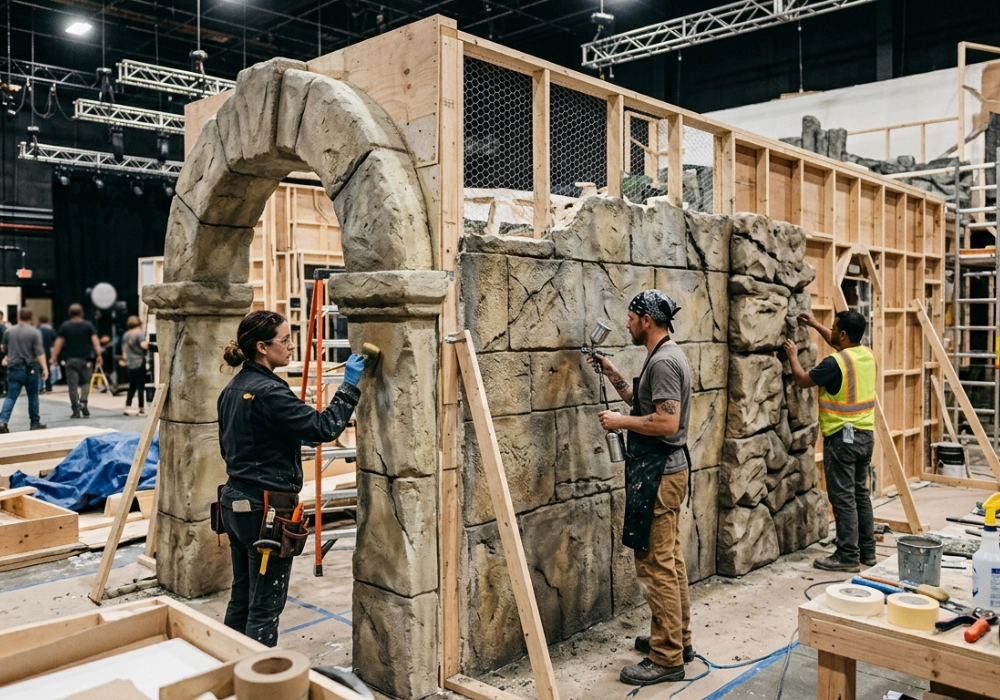
One of the fundamental challenges of scenic fabrication is creating the appearance of substantial, permanent construction without necessarily building everything from traditional construction materials.
A massive stone wall doesn’t have to be made from stone.
An architectural column doesn’t have to be solid concrete.
A carved monument doesn’t have to be carved from a single block.
Modern fabrication techniques allow scenic builders to create the appearance of weight, scale, texture, and permanence while using materials selected specifically for production requirements.
Foam, fiberglass, wood, plastics, composites, metal, and other materials can be combined to create strong, lightweight, transportable scenic elements.
The finished surface can then be treated to create the desired visual effect.
Foam Sculpting for Scenic Environments
Foam is an especially versatile material for large scenic fabrication.
Large blocks can be CNC cut or robotically sculpted into complex forms with remarkable consistency.
This makes foam useful for creating:
- Rock formations
- Mountains and landscapes
- Sculptural architecture
- Large architectural details
- Carved stone
- Fantasy structures
- Oversized scenic elements
- Organic forms
- Themed environments
- Architectural replicas
Once sculpted, foam can be coated and finished to withstand the demands of production while achieving the desired appearance.
What begins as a lightweight block can ultimately look like carved stone, concrete, timber, metal, rock, or an entirely fictional material.
Fiberglass & Composite Scenic Elements
Fiberglass and composite fabrication provide another powerful option for scenic environments.
These materials can produce strong, relatively lightweight shells with complex shapes and durable surfaces.
Fiberglass can be particularly effective when a scenic element needs to maintain a specific shape while remaining practical to transport and install.
Applications can include:
- Large sculptural elements
- Architectural components
- Themed structures
- Rockwork
- Decorative features
- Large-scale replicas
- Character and creature environments
- Specialty scenic pieces
Fiberglass can also be combined with other materials to create hybrid scenic assemblies.
Metal Fabrication Behind the Illusion
Not everything in a scenic environment is about appearance.
Sometimes the scenic element needs an engineered structural framework to support its own weight, withstand handling, or accommodate other production requirements.
Metal fabrication can provide the underlying structure for large scenic pieces while allowing other materials to create the visible surface.
Custom tube structures, welded frames, brackets, supports, platforms, and other fabricated components can be incorporated into scenic environments when additional strength is required.
The finished audience may never know what is happening beneath the surface.
That’s exactly the point.
Scenic Finishing Creates the Illusion
Fabrication establishes the shape.
Scenic finishing makes the audience believe it.
A newly fabricated component rarely looks like the final environment when it first leaves the shop.
It may need to be aged, weathered, distressed, textured, painted, coated, or otherwise transformed.
A new wall can be made to look decades old.
Freshly sculpted foam can become ancient stone.
A fabricated surface can be made to resemble rusted steel, polished marble, weathered timber, concrete, plaster, brick, or virtually any other material.
Scenic finishing gives production designers the ability to control the visual language of an environment down to the smallest details.
And because film and television cameras can capture details that audiences might never notice in person, those details matter.
Large-Scale Scenic Environments
Some productions need more than individual scenic pieces.
They need an entire world.
Large-scale scenic environments may include multiple interconnected structures, architectural elements, platforms, facades, landscapes, props, signage, sculptural elements, and specialty finishes.
Projects at this scale require careful coordination.
Components need to fit together. Installation needs to be planned. Transportation needs to be considered. Structural requirements need to be addressed.
Most importantly, every individual component needs to support the visual story of the overall environment.
That requires fabrication teams to think beyond individual pieces and understand the environment as a complete system.
Immersive Environments for Film & Television
An immersive environment doesn’t simply provide scenery.
It surrounds the viewer.
These environments can be especially effective for productions where the setting needs to feel expansive, detailed, and believable.
Examples include:
Futuristic environments
Laboratories, spacecraft interiors, advanced industrial facilities, fictional technology centers, and other imagined spaces.
Historical environments
Period architecture, streetscapes, interiors, storefronts, monuments, and architectural details designed to establish a specific time and place.
Fantasy environments
Fictional architecture, magical landscapes, mythical structures, oversized scenic elements, and environments that exist entirely within an imagined world.
Commercial environments
Restaurants, retail spaces, hospitality environments, branded interiors, product environments, and highly controlled visual settings for advertising and branded content.
The common thread is simple: the environment needs to tell part of the story.
Scenic Fabrication Requires Multiple Disciplines
A complex environment rarely comes from one fabrication technique.
A single scenic build might involve:
3D modeling → CNC cutting → foam sculpting → metal fabrication → carpentry → fiberglass → assembly → scenic finishing.
Each discipline contributes something different.
Digital modeling creates precision.
CNC technology creates repeatability.
Metal fabrication provides structure.
Carpentry creates architectural form.
Foam sculpting creates complex shapes.
Fiberglass provides durable lightweight shells.
Finishing creates realism.
The best result often comes from combining those capabilities rather than relying on a single process.
Technology Meets Craftsmanship
Modern fabrication technology has dramatically expanded what can be built for film and television.
Large-format CNC equipment can produce complex components with precision. Robotic foam cutting can create large sculptural forms. 3D printing can produce intricate details and custom components. Digital modeling can allow complex environments to be planned before fabrication begins.
But technology alone doesn’t create a convincing environment.
It still takes experienced fabricators to understand materials, construction methods, tolerances, assembly, finishing, and the practical realities of production.
At Statement Fabrication, we combine advanced fabrication technology with hands-on craftsmanship to create scenic environments that are both visually compelling and physically achievable.
Designed for Production
Scenic environments have to function in the real world.
They may need to be transported to a soundstage, backlot, studio, commercial location, event venue, or other production site.
They may need to be assembled quickly, modified between scenes, accessed by cameras and crew, or repeatedly used throughout a production.
That means the fabrication process needs to consider the entire lifecycle of the environment.
How will it be transported?
How will it be assembled?
Where will cameras go?
How will lighting access the environment?
Can components be removed or repositioned?
How will the finished environment hold up during production?
These questions are part of good scenic fabrication.
From an Empty Space to a Believable World
An empty soundstage is just an empty soundstage.
With the right combination of design, fabrication, materials, finishing, lighting, and camera work, it can become almost anything.
A city.
A palace.
A spaceship.
A nightclub.
A laboratory.
A historical street.
A fictional world.
That’s the power of scenic fabrication.
At Statement Fabrication, we help production teams take those ambitious environments from concept to physical reality.
Our Las Vegas fabrication facility brings together 3D modeling and design, CNC cutting, foam sculpting, metal fabrication, carpentry and millwork, fiberglass fabrication, 3D printing, and specialty finishing under one roof.
The result is a fabrication partner capable of tackling everything from individual scenic elements to highly complex, large-scale environments.
Build the World Behind the Story
The audience may never think about how the environment was built.
They shouldn’t have to.
They should simply believe it.
That’s what great scenic fabrication accomplishes.
Statement Fabrication builds custom scenic environments, architectural elements, large-scale scenic pieces, and immersive production environments for film and television.
Have a world that needs to be built?
Let’s make it real.