


When preparation matters, realism matters.
Military personnel are routinely asked to operate in challenging, complex, and rapidly changing environments. Effective training requires more than classroom instruction—it requires hands-on experiences that allow teams to practice, adapt, evaluate, and improve before real-world situations occur.
That is why training and simulation environments play such an important role across military and defense operations.
At Statement Fabrication, we specialize in training and simulation environment fabrication for military organizations, government agencies, and defense contractors, helping transform concepts into realistic physical environments that support education, preparedness, mission rehearsal, and operational training.
From immersive training structures and facility mockups to mission-focused environments, equipment replicas, and custom simulation components, we fabricate solutions that help organizations create more effective training experiences.
Because better preparation starts with better environments.
What Are Military Training & Simulation Environments?
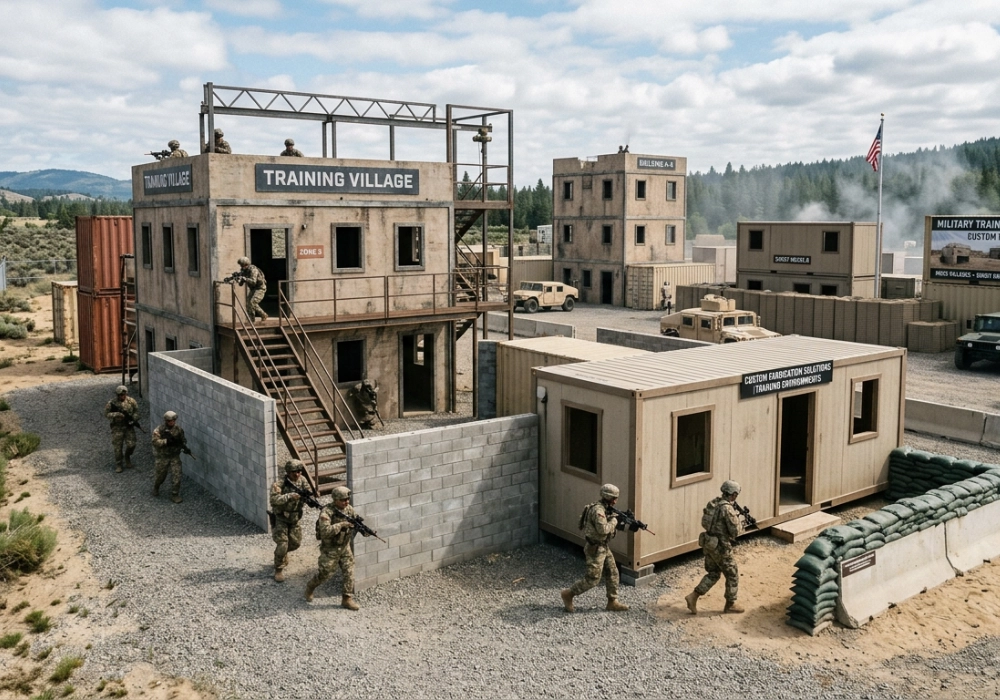
Training and simulation environments are purpose-built physical spaces or fabricated assets designed to support realistic training exercises.
These environments can range from simple instructional mockups to highly immersive structures that replicate operational conditions.
Examples may include:
- Facility mockups
- Training structures
- Equipment training aids
- Mission rehearsal environments
- Tactical training assets
- Scenario-based training spaces
- Simulation support structures
- Interactive instructional environments
- Observation and evaluation features
- Custom-built training props
- Specialized educational displays
- Physical simulation components
Every project is unique because every training objective is unique.
The goal is not simply to build a structure.
The goal is to support learning, repetition, and readiness.
Why Realistic Training Environments Matter
Military personnel often perform complex tasks in environments where precision, communication, and decision-making are critical.
Training environments help bridge the gap between theory and practical application.
Realistic environments can help:
- Improve retention
- Increase confidence
- Support team coordination
- Enhance situational awareness
- Improve procedural familiarity
- Strengthen decision-making
- Support mission readiness
- Create repeatable training opportunities
The more effectively a training environment reflects the intended learning objectives, the more valuable the training experience becomes.
Creating Immersive Training Experiences
Immersion plays a major role in successful training.
People learn differently when they are actively engaged within an environment rather than simply observing information.
Custom fabrication can help create spaces that support realistic scenarios through:
- Physical structures
- Environmental details
- Architectural elements
- Custom props
- Visual references
- Interactive components
- Equipment integrations
- Scenario-specific features
These elements help participants focus on the training objectives while creating a more engaging learning experience.
Facility & Infrastructure Mockups
Many military and defense training programs utilize mockups of facilities, structures, or operational environments.
These may be used for:
- Familiarization
- Orientation
- Training exercises
- Procedural instruction
- Operational planning
- Team coordination
Custom fabrication allows structures to be developed around specific training goals while supporting repeatable use over time.
Depending on the application, projects may include architectural features, room layouts, equipment representations, access points, or instructional components.
Simulation Support Structures
Not all simulation environments are entirely digital.
Many training systems require physical infrastructure to support equipment, technology, and instructional activities.
Fabricated support structures may include:
- Simulator housings
- Training stations
- Equipment frameworks
- Operator environments
- Observation platforms
- Control-room components
- Scenario support structures
- Custom enclosures
These physical elements help create organized, functional environments where simulation technologies can operate effectively.
Equipment Familiarization & Training Aids
Hands-on learning remains a valuable component of many training programs.
Custom fabrication can support educational objectives through:
- Equipment replicas
- Instructional models
- Physical demonstrations
- Cutaway displays
- Training mockups
- Orientation tools
- Learning aids
- Visualization models
These assets help personnel better understand systems, procedures, and operational concepts.
They can also provide cost-effective alternatives when access to operational equipment is limited.
Mission-Focused Training Environments
Every training environment should be built around a clearly defined objective.
That objective may involve:
- Operational readiness
- Team coordination
- Equipment use
- Facility familiarity
- Communication procedures
- Instructional training
- Emergency preparedness
- Scenario-based learning
Custom fabrication allows environments to be tailored specifically to the mission and learning outcomes required by the organization.
The environment supports the training rather than forcing training to fit the environment.
Modular & Adaptable Training Solutions
Training requirements evolve.
Procedures change.
Technologies advance.
Programs expand.
Because of this, many organizations benefit from environments that can be modified or reconfigured over time.
Fabricated training assets may be designed to support:
- Modular layouts
- Expandable systems
- Future upgrades
- Component replacement
- Multiple training scenarios
- Flexible configurations
Adaptability helps maximize the long-term value of the investment.
Supporting Military Education & Instruction
Training environments are not limited to operational exercises.
Many military educational programs benefit from fabricated instructional assets.
Examples include:
- Technical education displays
- Historical exhibits
- Equipment demonstrations
- Classroom enhancements
- Orientation centers
- Mission brief environments
- Interactive learning spaces
These environments help support communication, understanding, and engagement throughout the learning process.
Durability for Demanding Applications
Training assets often experience intensive use.
Unlike temporary displays or commercial installations, military training environments may be used repeatedly by large numbers of personnel.
Projects often require consideration for:
- Long service life
- Repetitive use
- Maintenance access
- Structural durability
- Transportation requirements
- Operational flexibility
Material selection and fabrication methods play an important role in long-term performance.
The goal is to create reliable assets capable of supporting ongoing training programs.
Fabrication Capabilities for Military Training Projects
Successful training environments frequently combine multiple fabrication disciplines.
Metal Fabrication
Metal components provide structural strength, durability, and long-term reliability.
Carpentry & Millwork
Custom structures, room environments, instructional spaces, and architectural features can be fabricated to meet project requirements.
Fiberglass Fabrication
Fiberglass supports lightweight components, complex shapes, and specialty applications.
Large-Format 3D Printing
Rapid production of custom components, models, mockups, and specialty training assets.
CNC Cutting & Processing
Precision manufacturing of panels, structural elements, instructional displays, and custom components.
Foam Sculpting
Large-scale shapes, themed environments, demonstration models, and specialty structures.
Combining these capabilities allows highly customized solutions to be developed efficiently.
Supporting Defense Contractors & Military Organizations
Training and simulation fabrication may support:
- Military installations
- Defense contractors
- Government agencies
- Military education programs
- Training commands
- Research organizations
- Technical schools
- Support facilities
Every organization has unique requirements, objectives, and operational considerations.
Custom fabrication helps create solutions tailored to those needs.
From Concept to Training Asset
Training projects often begin with a challenge:
How do we create an environment that effectively supports this learning objective?
Statement Fabrication helps move projects through:
Concept Development → 3D Modeling → Engineering Support → Fabrication → Finishing → Assembly → Installation Coordination
This process allows complex ideas to become functional, repeatable training assets.
Military Training Environment Fabrication in Las Vegas
Statement Fabrication provides advanced fabrication capabilities for military, government, and defense-related projects, including:
- Custom Fabrication
- Metal Fabrication
- Carpentry & Millwork
- Fiberglass Fabrication
- Foam Sculpting
- Large-Format 3D Printing
- CNC Cutting & Processing
- Prototype Development
- Specialty Finishing
- Complex Assemblies
Our ability to combine multiple manufacturing disciplines under one roof allows us to support unique projects that require both creativity and technical execution.
Better Training Starts With Better Environments
The effectiveness of a training program depends on many factors.
But one factor remains consistent:
People learn best when they can experience, practice, and engage with realistic environments.
Statement Fabrication specializes in training and simulation environment fabrication for military organizations, government agencies, and defense contractors, helping create physical assets that support readiness, education, and operational success.
Whether you’re developing a training facility, simulation environment, instructional asset, equipment mockup, or mission-focused training structure, we’re ready to help bring your vision to life.
Because preparation is never accidental.
It’s built through training.
We Build Statements.