



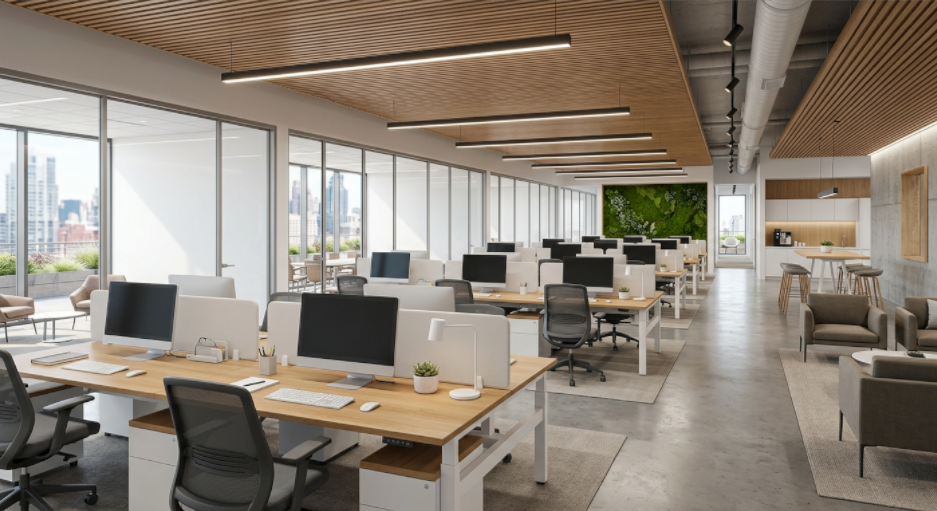
Choosing the Right Fabrication Partner for Your Corporate Project
Corporate fabrication projects often begin with a vision: a distinctive reception area, an architectural centerpiece, a branded workplace, a custom showroom, or a specialty feature that makes a business environment stand out.
But turning that vision into a finished physical product requires more than a good idea.
The right fabrication partner needs to understand the design, evaluate the materials, identify appropriate construction methods, and coordinate the details required to produce a successful result.
Choosing a corporate fabrication company is therefore an important decision. The fabricator’s capabilities, experience, communication, craftsmanship, and ability to solve problems can all influence the final project.
Whether you are planning a single custom installation or a larger corporate environment, here are the factors worth evaluating before choosing a fabrication partner.
1. Look for Experience Relevant to Your Project
Not all fabrication companies specialize in the same types of work.
Some focus primarily on cabinetry and traditional millwork. Others specialize in signage, metal fabrication, commercial construction, exhibits, or large-scale scenic projects.
Your project may require one discipline or several.
For example, a custom reception area might involve carpentry, metal supports, specialty finishes, and dimensional branding. A large sculptural installation could require digital modeling, structural components, CNC foam carving, fiberglass, and paint finishing.
Ask prospective fabricators whether they have completed work involving similar materials, dimensions, complexity, and intended applications.
A relevant portfolio is more useful than a broad claim that a company can build anything.
2. Evaluate the Company’s Fabrication Capabilities
One of the most important questions is whether the fabricator has the capabilities needed to produce your project.
Depending on the design, corporate fabrication may involve:
- Metal fabrication and welding
- Carpentry and custom millwork
- Fiberglass fabrication
- Foam sculpting and CNC foam carving
- 3D modeling and design
- 3D printing and prototyping
- CNC cutting and precision machining
- Specialty finishing and coatings
- Custom assembly and component integration
A project involving several different materials may require multiple vendors if one company has limited capabilities.
A multidisciplinary fabrication partner may be able to coordinate more of the work within one operation. This can simplify communication and help maintain consistency across components.
However, capabilities should be verified. Ask which processes are performed in-house, which are handled by partners, and how responsibility is divided.
3. Review the Quality of the Company’s Previous Work
A portfolio provides insight into a fabricator’s craftsmanship and attention to detail.
Look beyond the overall appearance of completed projects. Pay attention to the quality of the actual construction.
Consider:
- Are edges, seams, joints, and transitions clean?
- Do finishes appear consistent?
- Are complex shapes and details executed accurately?
- Do multiple materials work together naturally?
- Does the finished work appear appropriate for its intended environment?
- Can the company show examples of projects with comparable scale or complexity?
Photographs can be helpful, but additional information about the fabricator’s role is important. A company may have contributed one component to a larger project rather than produced the entire environment.
Ask what work the company was directly responsible for and whether it can provide additional project details.
4. Understand Its Design and Engineering Process
Some clients arrive with completed construction documents and detailed specifications. Others have a concept, reference images, sketches, or an early-stage rendering.
A capable fabrication partner should be able to explain how it works with the information provided.
Questions to consider include:
- Can the company review existing drawings and specifications?
- Can it help develop a concept into a production-ready design?
- Does it offer 3D modeling or visualization?
- Can it identify practical material and construction options?
- How are dimensions, connections, and assembly details reviewed?
- Does the project require engineering by a qualified professional?
Not every fabricator provides architectural design or structural engineering. It is important to understand the scope of its services and determine which responsibilities belong to the architect, engineer, contractor, or other project professionals.
For large, suspended, load-bearing, or publicly accessible installations, appropriate engineering and code review should be addressed before fabrication begins.
5. Ask About Materials and Finishing
The materials used in a corporate environment affect its appearance, durability, weight, maintenance, and cost.
A fabricator should be able to explain why certain materials are appropriate for the intended application.
For example:
- Metal may be appropriate for structural frameworks and durable architectural details.
- Wood and millwork materials can create custom cabinetry, counters, and wall treatments.
- Fiberglass can produce complex shapes and specialty finished components.
- Foam can be carved into dimensional forms and sculptures, with suitable coatings selected for the application.
- 3D-printed components can support detailed shapes, prototypes, and specialty parts.
The visible finish is equally important. A custom feature may combine several materials, but the finished product should look intentional and cohesive.
Discuss color matching, textures, paint systems, gloss levels, durability, cleaning, and maintenance requirements before production.
6. Evaluate Communication and Project Management
Even a highly skilled fabrication team can struggle when communication is inconsistent.
Corporate projects often involve several stakeholders, including business owners, marketing departments, designers, architects, general contractors, property managers, and facility teams.
The fabricator should be able to explain how information is managed throughout the project.
Look for a company that:
- Establishes a clear project scope
- Identifies required drawings and approvals
- Communicates material and design considerations
- Provides realistic production expectations
- Documents important changes
- Coordinates with other project stakeholders
- Identifies potential issues before they affect production
A good fabrication partner should be willing to raise questions and discuss potential problems rather than simply accepting a design that may be difficult to produce.
7. Confirm Production Capacity and Scheduling
Corporate projects frequently operate within larger construction, renovation, or relocation schedules.
A delayed fabricated component can affect other trades and activities. Before selecting a company, discuss its current production capacity and the schedule required for your project.
Ask about:
- Estimated design and development time
- Material procurement
- Production lead times
- Prototype or sample approvals
- Finishing and quality-control stages
- Packaging and transportation requirements
- Delivery and installation coordination, if included
If the project involves multiple components, ask how they will be sequenced and tracked.
Avoid choosing a fabricator based only on an aggressive promised deadline. A realistic schedule that accounts for approvals, materials, production, and coordination is more useful than an estimate that leaves out important steps.
8. Compare Proposals Beyond the Bottom-Line Price
When comparing fabrication proposals, make sure you understand what each company is actually offering.
Two proposals may have significantly different prices because they include different materials, construction methods, finishes, design work, or levels of project coordination.
Review each proposal for:
- Clearly defined scope
- Material specifications
- Dimensions and quantities
- Finish requirements
- Design and engineering responsibilities
- Included revisions or approvals
- Packaging and delivery
- Assembly or installation scope
- Exclusions and assumptions
- Payment terms and schedule
The lowest price is not automatically the best value.
A proposal should make it clear what will be delivered, how it will be built, and which responsibilities remain with the client or other project partners.
9. Understand Delivery, Assembly, and Installation Responsibilities
Fabrication does not automatically include every service required to put a finished project in place.
Some components are delivered ready for use. Others require on-site assembly, specialized handling, rigging, electrical coordination, or installation by qualified trades.
Before approving a proposal, clarify:
- Who is responsible for transportation?
- Will components arrive assembled or in sections?
- Is on-site assembly required?
- Who coordinates installation?
- Are lifts, rigging, or special equipment needed?
- Are permits or site approvals required?
- Who is responsible for final connections and inspections?
These details are particularly important for large architectural features, multi-piece installations, and projects taking place in active commercial buildings.
The scope should be clearly documented rather than assumed.
Questions to Ask a Corporate Fabrication Company
Before selecting a partner, consider asking:
- Have you completed projects similar to ours?
- Which fabrication processes do you perform in-house?
- Can you work from our existing drawings or help develop the design?
- What materials would you recommend for this application?
- How do you review dimensions, connections, and construction details?
- What does your production schedule look like?
- How do you manage changes and approvals?
- Can you provide examples of comparable finished work?
- What is included in your proposal, and what is excluded?
- Can you support delivery, assembly, or installation if required?
The answers should help you understand not only what the company can build, but how it approaches the work.
Why Consider Statement Fabrication?
Statement Fabrication is a Las Vegas-based custom fabrication company with a broad range of capabilities for businesses, designers, and organizations developing distinctive commercial environments.
Our work brings together multiple fabrication disciplines, including metal fabrication, carpentry and millwork, fiberglass, foam sculpting, 3D modeling and printing, and specialty finishing.
This range of capabilities allows our team to approach projects that require more than one material or construction method. We enjoy working through complex concepts, evaluating practical ways to build them, and producing custom features that are designed around the project rather than limited to standard products.
Our approach is built around four important strengths:
Experience: Understanding the challenges that come with custom fabrication and complex builds.
Technology: Using modern modeling, machining, cutting, and production capabilities to support precision and efficiency.
Craftsmanship: Paying attention to the details that distinguish a finished product.
Execution: Bringing the people, processes, and fabrication disciplines together to move a project from concept toward completion.
Most importantly, our team is the foundation of what we do. The combination of experience, creativity, technical knowledge, and hands-on craftsmanship makes ambitious projects possible.
Choose a Fabrication Partner That Can Bring the Vision to Life
The right corporate fabrication company should offer more than production capacity. It should understand the design intent, communicate clearly, recognize potential challenges, and have the capabilities needed to build the finished product.
Whether you are developing a corporate headquarters, updating a reception area, creating a branded customer experience center, or producing a one-of-a-kind architectural feature, take the time to evaluate the people and processes behind the proposal.
Statement Fabrication builds custom features, structures, and environments for businesses looking to create something beyond the ordinary.
Contact Statement Fabrication to discuss your next corporate fabrication project.
Frequently Asked Questions
What should I look for in a corporate fabrication company?
Look for relevant experience, in-house capabilities, quality craftsmanship, material knowledge, clear communication, and a well-defined project scope.
Can a corporate fabricator work with our architect or interior designer?
Yes. Fabricators commonly coordinate with architects, designers, contractors, and other project stakeholders to develop and produce custom elements.
Does a corporate fabrication company need to provide engineering?
Not necessarily. Engineering responsibilities depend on the project and should be clearly assigned to qualified professionals when required.
Is custom corporate fabrication more expensive than standard products?
It can be, depending on complexity and materials, but custom fabrication provides solutions tailored to specific design and functional requirements.
Can one fabricator handle metal, wood, fiberglass, and foam?
Some multidisciplinary fabricators offer several of these capabilities in-house. Confirm which processes are performed directly by the company.
How early should a fabricator be involved?
Early involvement is generally beneficial because it allows materials, construction methods, dimensions, and production requirements to be considered before designs are finalized.
Should delivery and installation be included in the fabrication proposal?
They should be discussed and clearly defined. Delivery, assembly, rigging, and installation are often project-specific services rather than automatic inclusions.
Why choose Statement Fabrication for a corporate project?
Statement Fabrication offers multiple fabrication disciplines and advanced production capabilities for businesses seeking custom architectural features, branded environments, and specialty builds.