


Walk into a well-designed themed environment and you may feel like you’ve stepped somewhere completely different. A convention hall can become an ancient city. A stage can transform into another world. A corporate event can become an immersive brand experience.
Behind many of these environments is a surprisingly versatile material: foam.
Foam is widely used in themed environments, foam fabrication, and scenic fabrication because it can be shaped into enormous architectural features, intricate sculptures, dimensional signage, realistic rockwork, props, and detailed decorative elements without the weight and construction demands of many traditional materials.
When combined with CNC foam carving, 3D modeling, coatings, painting, and skilled craftsmanship, foam allows fabrication teams to turn highly imaginative concepts into physical environments that audiences can walk through and experience.
What Are Themed Environments?
Themed environments are physical spaces designed around a particular story, concept, brand, setting, or visual identity.
Instead of simply decorating a space, themed environments transform the space itself.
They may be created for:
- Theme parks
- Casinos
- Hotels and resorts
- Concerts
- Festivals
- Corporate events
- Trade shows
- Brand activations
- Museums
- Experiential marketing
- Film and television
- Immersive entertainment
A themed environment might recreate an architectural style, create a fantasy world, reinforce a brand identity, or transport visitors into an entirely fictional setting.
The goal is to make the environment feel intentional, immersive, and believable.
Why Is Foam Used for Themed Environments?
Foam provides a unique combination of flexibility, low weight, scalability, and sculptability.
A large feature made from traditional materials can become extremely heavy and difficult to transport.
Foam provides an alternative.
A lightweight foam structure can be shaped into a massive architectural feature and then coated and finished to resemble stone, concrete, wood, metal, plaster, rock, or other materials.
This gives designers significant freedom without requiring the finished object to actually be constructed from the material it appears to represent.
Foam Can Be Made to Look Like Almost Anything
One of the biggest advantages of foam fabrication is its ability to create visual illusions.
A foam structure can be transformed through scenic finishing into:
- Ancient stone
- Weathered concrete
- Brick
- Carved wood
- Metal
- Rock
- Marble
- Plaster
- Futuristic architecture
- Fantasy structures
The foam creates the shape.
Scenic fabrication creates the illusion.
This combination is what makes foam so powerful for immersive environments.
How Foam Themed Environments Are Built
Creating a large-scale themed environment involves much more than cutting foam into shapes.
A successful project combines creative development, digital modeling, engineering, fabrication, sculpting, finishing, logistics, and installation.
Here’s how the process typically works.
1. Develop the Creative Concept
Every themed environment starts with a creative vision.
The concept may come from an event producer, experiential agency, architect, designer, entertainment company, brand, or creative director.
The initial concept might consist of:
- Sketches
- Renderings
- Mood boards
- Reference images
- CAD drawings
- 3D models
- Brand guidelines
At this stage, the fabrication team begins evaluating how the visual concept can become a physical environment.
Important considerations include:
- Overall scale
- Audience interaction
- Location
- Installation time
- Transportation
- Structural requirements
- Materials
- Budget
- Reusability
Bringing fabrication expertise into the process early can help identify potential challenges before production begins.
2. Develop the 3D Model
Once the concept is established, designers and fabricators can develop detailed digital models.
3D modeling allows the team to determine:
- Dimensions
- Proportions
- Component relationships
- Assembly points
- Structural requirements
- Material requirements
- Transportation considerations
For large themed environments, digital modeling is particularly valuable because the project may contain hundreds of individual components.
The digital model becomes the blueprint for fabrication.
3. Break the Environment Into Fabricated Components
A massive themed environment rarely arrives at the venue as one giant piece.
Instead, it is broken down into manageable sections.
These sections may include:
- Wall panels
- Architectural facades
- Columns
- Arches
- Sculptures
- Platforms
- Decorative features
- Signs
- Props
- Structural frames
Breaking the environment into modular components makes it easier to manufacture, transport, install, remove, and potentially reuse.
Precision CNC Foam Carving and Shaping Services
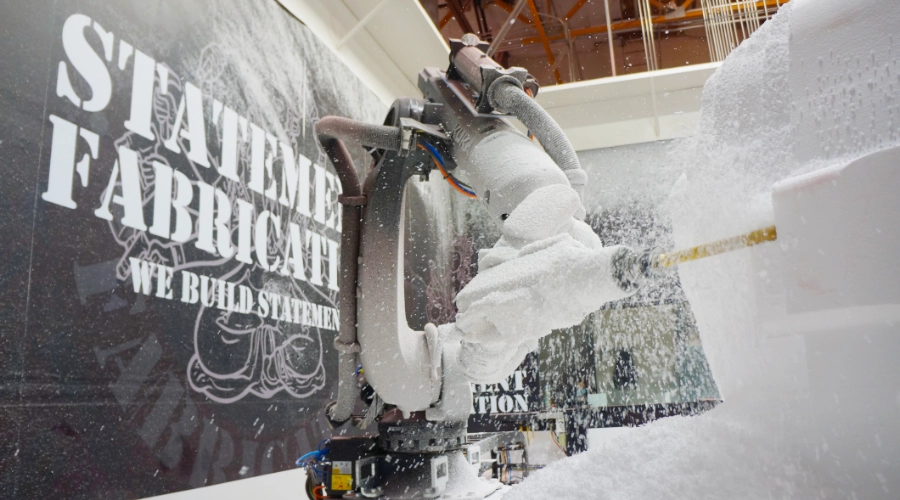
Once the digital design is ready, foam can be shaped using CNC technology.
CNC foam carving uses computer-controlled equipment to cut and sculpt foam according to a digital model.
This can create:
- Large architectural forms
- Sculptures
- Dimensional lettering
- Rockwork
- Decorative details
- Complex curves
- Organic shapes
CNC carving is particularly valuable when precision, repeatability, and speed are important.
For large projects, it can dramatically reduce the time required to create the basic form.
5. Hand Sculpting and Foam Fabrication
CNC equipment creates the primary geometry, but skilled fabricators can refine the surface by hand.
This is where foam fabrication and traditional craftsmanship come together.
Fabricators may:
- Refine curves
- Add surface texture
- Carve details
- Modify transitions
- Blend multiple pieces
- Correct imperfections
- Create hand-sculpted elements
This combination allows the project to achieve both digital precision and artistic character.
6. Assemble the Foam Components
Large structures are typically fabricated in sections.
Those components may be assembled in the shop to verify:
- Fit
- Alignment
- Dimensions
- Connections
- Structural interfaces
- Installation sequence
Whenever possible, test assembly before shipping can help identify issues before the project reaches the event site.
This is especially important for temporary themed environments where installation windows may be extremely short.
7. Add Structural Support
Foam is lightweight, but large scenic elements may still require internal support.
Depending on the application, fabricated foam components may incorporate:
- Metal frames
- Wood structures
- Internal supports
- Mounting systems
- Anchoring points
- Reinforcement
The structural system is designed around how the component will be transported, installed, and used.
The foam provides the visual form while the underlying structure provides the necessary support.
8. Apply Protective Coatings
Raw foam generally needs additional treatment before being placed into many event or scenic environments.
Protective coatings can:
- Strengthen the surface
- Protect against damage
- Create a durable exterior
- Prepare the surface for painting
- Improve handling and transportation
The specific coating system depends on the foam type and the requirements of the project.
9. Scenic Finishing Creates the Illusion
This is where scenic fabrication becomes especially important.
A CNC-carved foam wall may have the correct shape, but it does not necessarily look like stone.
Scenic artists and finishers transform the raw component into a convincing environment.
Techniques may include:
- Faux painting
- Texturing
- Aging
- Distressing
- Airbrushing
- Highlighting
- Shading
- Metallic finishes
- Weathering
- Custom color matching
A skilled scenic finisher can make lightweight foam look surprisingly convincing.
10. Transportation and Installation
Once fabrication and finishing are complete, the environment needs to reach its destination.
Because themed environments can be extremely large, transportation must be considered from the beginning.
Fabricators may need to account for:
- Truck dimensions
- Component weight
- Loading sequence
- Site access
- Elevators
- Doorways
- Forklift access
- Cranes
- Installation equipment
Designing the environment as modular components makes transportation and installation considerably more manageable.
Foam Fabrication for Large-Scale Scenic Environments
Foam is particularly effective when a project needs to create a dramatic visual impact without constructing everything from heavy conventional materials.
Large foam elements can be used to create:
Architectural Facades
Buildings, walls, columns, arches, entrances, and decorative architectural features can be fabricated from foam and finished to resemble other materials.
Rockwork
Foam can be carved into realistic rock formations, cliffs, boulders, caves, and geological features.
Sculptures
Large sculptures can be created from digital models and CNC-carved foam before being refined and finished.
Oversized Props
Brands and entertainment productions often need objects that are intentionally larger than life.
Foam makes these oversized elements easier to fabricate and transport.
Dimensional Signage
Large letters, logos, numbers, and branded elements can be CNC-cut and finished to create substantial visual impact.
Foam in Event Fabrication
Event fabrication frequently requires structures that are impressive, temporary, lightweight, and fast to install.
Foam can meet many of these requirements.
For concerts, festivals, trade shows, corporate events, and experiential activations, foam fabrication can create environments that dramatically change the appearance of an existing venue.
A convention center can become a futuristic city.
A ballroom can become an immersive brand environment.
A stage can become an elaborate architectural world.
The possibilities are largely limited by the creative concept and fabrication requirements.
Why Foam Works So Well for Temporary Environments
Many themed environments are temporary.
They may exist for:
- One evening
- Several days
- A week-long event
- A touring production
- A seasonal activation
- A limited-time attraction
That makes lightweight construction particularly valuable.
Foam can reduce the weight of large scenic components while still providing substantial visual volume.
This can simplify:
- Transportation
- Installation
- Dismantling
- Storage
- Reuse
For touring or recurring productions, components can potentially be designed for repeated installation.
Can Foam Themed Environments Be Reused?
Yes.
A well-designed environment can be engineered and fabricated with reuse in mind.
Components can be designed to:
- Break down into sections
- Store efficiently
- Reassemble repeatedly
- Replace damaged pieces
- Adapt to different layouts
This can make a significant difference for brands, event producers, touring productions, and organizations that plan to use scenic environments more than once.
Foam Fabrication vs. Traditional Construction
Foam fabrication is not intended to replace traditional construction in every application.
Instead, it provides a specialized approach for projects where appearance, weight, portability, and speed are important.
Traditional construction may be preferable when a structure needs to function as a permanent building or withstand long-term structural loads.
Foam fabrication can be particularly effective when the primary objective is creating a visual environment or experience.
The best projects often combine both.
A steel or wood framework may provide structural support while foam creates the architectural appearance.
What Makes High-Quality Scenic Fabrication?
Creating a convincing themed environment requires more than simply carving shapes from foam.
High-quality scenic fabrication combines:
- Creative interpretation
- 3D modeling
- CNC carving
- Foam sculpting
- Structural fabrication
- Assembly
- Surface preparation
- Scenic painting
- Specialty finishing
- Installation
The quality of the final environment depends on how well these disciplines work together.
The goal is to make the finished environment feel cohesive—from the largest architectural element down to the smallest detail.
The Future of Themed Environments
Technology is expanding what designers can create.
CNC foam carving, robotic fabrication, 3D printing, digital sculpting, advanced coatings, and modern scenic finishing are making increasingly ambitious environments possible.
At the same time, traditional craftsmanship remains essential.
The most successful themed environments combine technology and human skill.
Digital tools provide precision and efficiency.
Experienced fabricators and scenic artists provide creativity, judgment, and attention to detail.
Themed Environment and Foam Fabrication in Las Vegas
Las Vegas is a global center for entertainment, conventions, hospitality, experiential marketing, and large-scale events.
That creates a constant demand for custom themed environments, foam fabrication, and scenic fabrication.
At Statement Fabrication, we combine CNC foam carving, foam sculpting, 3D modeling, metal fabrication, carpentry, fiberglass, 3D printing, scenic finishing, and installation capabilities to create immersive physical environments.
From massive stage scenery and branded activations to themed architectural features, sculptures, props, and complete experiential environments, we can help take a concept from digital design to finished installation.
The material may be lightweight.
The experience doesn’t have to be.
We build statements.