


A great film or television set does more than provide a backdrop. It creates the physical world where a story takes place.
From a realistic residential interior to a massive commercial environment, period-specific location, futuristic laboratory, nightclub, restaurant, or completely fictional world, custom set construction transforms creative concepts into camera-ready environments.
At Statement Fabrication, we build custom sets and scenic environments for film, television, commercials, branded content, live productions, and other visual projects. Our fabrication capabilities allow production teams to move from drawings and concepts to precisely built, finished, and production-ready environments.
Building the World Behind the Story
The best sets often look effortless on camera.
That simplicity can be deceptive.
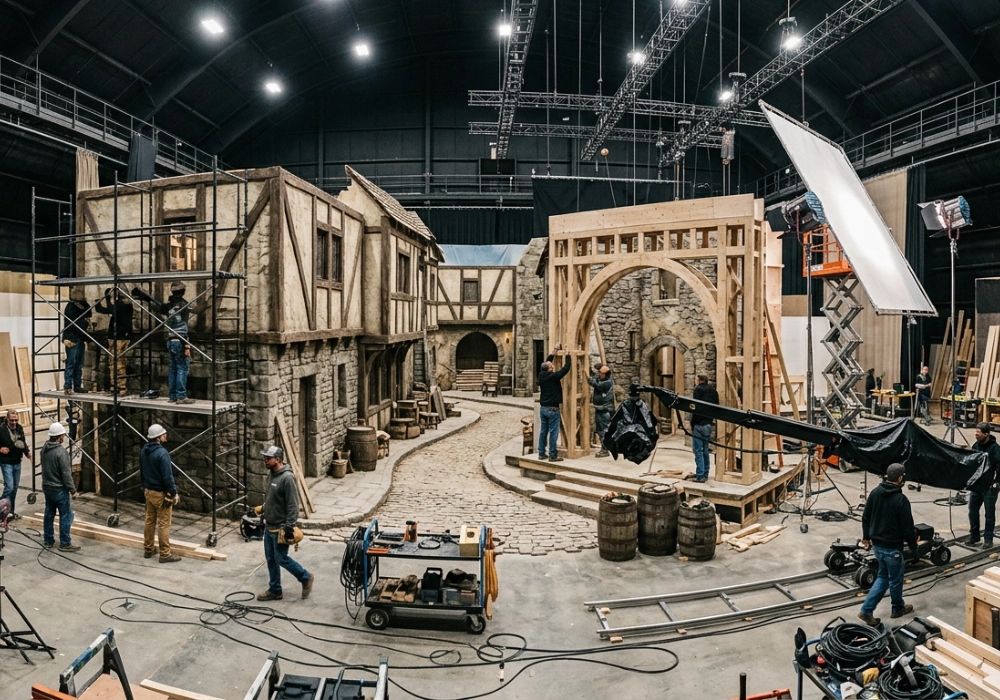
Behind a finished scene may be a carefully engineered combination of structural framing, millwork, metal fabrication, sculpted elements, specialty materials, scenic finishes, architectural details, and custom-built components.
Set construction is where the creative vision of the production designer and art department becomes a physical environment. Technical drawings, models, renderings, dimensions, materials, finishes, and production requirements all have to come together in a build that works not only visually, but practically.
The set may need to accommodate actors, cameras, lighting, sound equipment, crew movement, special effects, practical doors and windows, removable sections, or other production requirements.
In other words, a film set isn’t simply built to look good. It’s built to work.
Custom Set Construction Starts With the Camera
One of the biggest differences between ordinary construction and film and television set construction is the way the finished environment will be photographed.
A wall might need to appear completely solid from one camera angle while being removable from another. A room may need to look full-size on screen while using construction techniques that make it easier to transport or install. Architectural details may be exaggerated because of the distance from the camera, while other components require extremely realistic finishes because the camera will be only inches away.
This is why production requirements should influence construction from the beginning.
Important considerations can include:
- Camera angles and sightlines
- Actor movement and interaction
- Lighting positions and access
- Practical doors, windows, and fixtures
- Removable or accessible walls
- Camera and crew access
- Set dimensions and ceiling heights
- Structural requirements
- Transportation and installation
- Reuse, storage, or relocation
A successful set fabrication partner understands that the finished product has to perform for the production—not simply resemble the concept art.
From Concept to Camera-Ready Set
Every production is different, but custom set construction commonly progresses through several stages.
1. Concept & Design
The process begins with the creative direction.
Production designers, art directors, set designers, agencies, producers, and other members of the creative team may provide concept art, sketches, renderings, technical drawings, reference imagery, or even a rough idea that needs to be developed into something buildable.
The fabrication team evaluates the design and begins determining how the environment can actually be constructed.
2. Engineering & 3D Modeling
Complex sets benefit from detailed digital planning before fabrication begins.
3D modeling can help resolve dimensions, materials, component relationships, assembly methods, and potential production issues before anything is cut or built.
For large or complicated projects, this stage can be particularly valuable because changes made digitally are generally much easier to manage than changes made after fabrication has started.
It also allows the production team and fabrication team to work from a common visual reference.
3. Fabrication
Once the design and construction approach are established, fabrication begins.
Depending on the project, this can involve a combination of:
- Carpentry and custom millwork
- Metal fabrication and welding
- CNC cutting
- Laser cutting
- 3D printing
- Foam sculpting and CNC foam cutting
- Fiberglass fabrication
- Mold making
- Specialty materials
- Scenic fabrication
- Custom architectural elements
- Paint and specialty finishes
Using multiple fabrication disciplines under one roof can simplify complex productions. Instead of treating every component as a separate project, the different elements can be coordinated as one integrated build.
4. Finishing & Scenic Treatment
Construction creates the form. Finishing creates the illusion.
A newly fabricated wall may need to look decades old. A new architectural element may need to resemble carved stone. A fabricated surface might need to appear like aged wood, concrete, metal, marble, or another material.
Scenic finishing techniques can add texture, depth, weathering, aging, distressing, color variation, and other visual details that make a constructed environment believable on camera.
The objective isn’t necessarily to make every component look perfect up close.
The objective is to make the finished environment look exactly right for the shot.
5. Assembly & Installation
A set that looks impressive inside a fabrication shop still has to work at the production location.
Large sets may need to be broken down into manageable components for transportation and then assembled on site. Access points, elevators, loading docks, staging areas, installation schedules, and site conditions can all influence how the set is fabricated.
That means installation shouldn’t be treated as an afterthought.
The way a set comes apart can be just as important as the way it goes together.
Materials Matter
There is no single material that works for every film or television set.
Material selection depends on the visual requirements, physical demands, dimensions, installation method, budget, schedule, and how the set will be used.
A custom set might combine wood, plywood, steel, aluminum, foam, fiberglass, plastics, composites, printed components, and specialty materials within the same environment.
For example, a large architectural feature might use a lightweight structural framework combined with CNC-cut foam and fiberglass skins. A highly detailed interior could combine custom millwork with metal components and 3D-printed details.
The goal is to select the right construction method for the application, rather than forcing every project into the same fabrication process.
Built for More Than One Camera Angle
Film and television sets frequently need to do things that ordinary buildings don’t.
Walls may need to move.
Sections may need to be removable.
Ceilings may need to be omitted or partially constructed to provide camera and lighting access.
A staircase might need to withstand repeated use while remaining visually appropriate for the production.
A restaurant interior might require functioning counters, booths, doors, shelving, signage, and architectural elements—all constructed specifically for the production.
The fabrication process therefore has to account for both what the audience sees and what the production needs behind the camera.
That balance is one of the defining challenges of custom set construction.
Large-Scale Film & TV Set Construction
Some productions require much more than a traditional room set.
Large-scale fabrication can include entire environments, architectural facades, oversized scenic elements, immersive interiors, industrial environments, fantasy structures, commercial environments, and other highly customized builds.
These projects require a combination of creative problem-solving, engineering, fabrication expertise, equipment, and production coordination.
Large-format CNC equipment, laser cutting, metal fabrication, robotic foam cutting, 3D printing, fiberglass fabrication, and other technologies can make it possible to produce complex shapes and highly detailed components at significant scale.
Modern fabrication technology doesn’t replace craftsmanship.
It gives skilled fabricators more ways to execute it.
The Advantage of an Integrated Fabrication Partner
A complex production can involve dozens of individual components and multiple fabrication disciplines.
Managing those pieces through multiple vendors can create additional coordination, transportation, scheduling, and quality-control challenges.
An integrated fabrication partner can bring more of those capabilities together.
At Statement Fabrication, our capabilities span 3D modeling and design, carpentry, millwork, metal fabrication, fiberglass, foam sculpting, 3D printing, CNC cutting, and finishing.
That allows a project to move between disciplines while maintaining a consistent understanding of the overall design.
For production teams, that can mean fewer handoffs, better coordination, and a clearer path from concept to finished environment.
Safety Is Part of Set Construction
Film and television sets are active construction environments.
Set fabrication and installation can involve welding and cutting, power tools, lifts, scaffolding, rigging, heavy materials, elevated work, and other potential hazards. Industry safety organizations specifically recognize the construction nature of motion-picture and television production environments.
That makes proper planning and safe fabrication practices essential.
Construction methods should account for how set pieces will be handled, transported, installed, used, modified, and eventually removed. When appropriate, structural requirements, rigging considerations, fire safety, access, and other production-specific requirements should be addressed before fabrication begins.
A set may only exist for a few days or weeks, but it still needs to be constructed with the demands of production in mind.
Custom Sets Built for the Production
Every production has its own creative language.
Some sets need to disappear into the background and look completely authentic. Others are intentionally exaggerated and become characters in their own right.
Some need to be built quickly. Some need to withstand weeks of filming. Some need to travel. Others are enormous, highly detailed environments that exist almost entirely to create a single visual moment.
That’s why custom set construction can’t be reduced to a single construction method.
It requires the ability to understand the creative objective, determine how that vision can be physically achieved, and then execute the build with the right combination of technology, craftsmanship, materials, and production experience.
Build the World. Make the Statement.
At Statement Fabrication, we believe the environment surrounding the story deserves the same level of attention as the story itself.
From individual scenic elements to large-scale custom environments, we help film and television production teams turn creative concepts into physical spaces built for the camera.
Our Las Vegas fabrication facility combines advanced technology with hands-on craftsmanship across multiple fabrication disciplines, giving production teams a single partner capable of tackling highly customized projects.
Have a set, environment, or production concept that needs to become real?
Let’s build it.
Contact Statement Fabrication to discuss your next film or television set construction project.