


Custom Fabrication for Specialized Government Projects
Government facilities and public-sector organizations often require physical solutions that are designed around specific operational, architectural, educational, or public-facing needs.
Standard products can serve many purposes, but some projects require unique dimensions, specialized materials, custom configurations, or features that are simply unavailable through traditional suppliers.
Custom government fabrication provides the flexibility to build around those requirements.
From custom architectural features and public information displays to specialty structures, demonstration components, and fabricated assemblies, the possibilities are broad.
Statement Fabrication brings together multiple fabrication disciplines to support projects that require more than a single production process.
Custom Structures and Specialty Assemblies
Some government projects require structures and assemblies developed for a specific application.
These projects may involve unusual shapes, custom dimensions, specialized mounting requirements, or multiple components that need to work together.
Potential applications include:
- Custom metal frames and support structures
- Specialty enclosures and housings
- Fabricated brackets and mounting systems
- Custom platforms and display supports
- Protective covers and equipment surrounds
- Purpose-built fixtures and assemblies
- Specialty architectural structures
- Custom demonstration components
The design and fabrication approach depends on the intended use, loading conditions, environment, and technical specifications.
For components with structural or safety implications, engineering requirements should be established and reviewed by qualified professionals before production.
Custom Displays and Public Information Installations
Government agencies often need effective ways to communicate information to employees, visitors, and the public.
Custom fabricated displays can make information easier to understand while creating a more cohesive and professional environment.
Examples include:
- Public information displays
- Educational exhibit structures
- Historical and interpretive displays
- Dimensional signage features
- Custom display cases
- Interactive presentation structures
- Oversized models and replicas
- Branded visitor center installations
These displays can be built around the information being presented, the available space, and the way visitors will interact with them.
A custom exhibit may combine metal supports, wood construction, dimensional components, printed graphics, sculpted elements, and specialty finishes.
Government Building and Facility Features
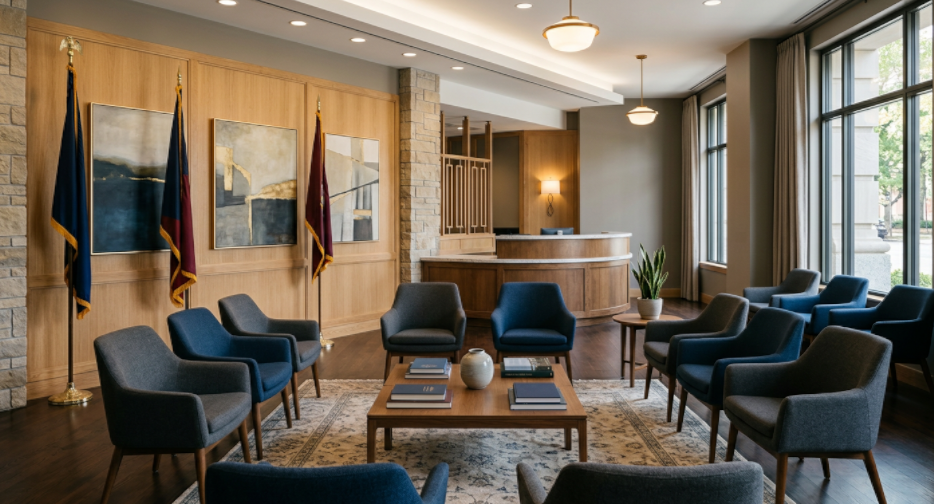
Government buildings can benefit from custom fabricated architectural elements that improve the appearance and functionality of their interiors and public areas.
Possible projects include:
Reception Areas and Service Counters
Custom reception desks, service counters, branded backdrops, and integrated display features can be designed around the dimensions and functions of a particular facility.
Architectural Feature Walls
Dimensional wall installations, specialty panels, decorative metalwork, and sculptural features can introduce visual interest while reinforcing the identity of a facility.
Custom Cabinetry and Millwork
Cabinetry, built-in storage, counters, work surfaces, and specialty fixtures can be designed for specific rooms and operational needs.
Public-Facing Fixtures
Custom information stations, display supports, specialty seating components, and other fixtures can be developed around public use, accessibility, and maintenance requirements.
These features should be coordinated with the building’s architectural plans and applicable construction standards.
Training and Demonstration Components
Some government organizations need physical components to support training, demonstrations, and technical communication.
Custom fabrication can help turn abstract concepts into physical objects that are easier to view, handle, demonstrate, or explain.
Potential applications include:
- Demonstration models
- Training display structures
- Equipment mockups
- Oversized component replicas
- Educational models
- Specialty presentation fixtures
- Non-operational demonstration assemblies
- Custom platforms and supports
The level of detail and functionality should be determined by the intended training application.
A visual demonstration model, for example, may have very different requirements from a functional test component. The fabricator should understand that distinction before materials and production methods are selected.
Custom Models, Prototypes, and Replicas
Digital design and modern production technology have expanded what can be created through custom fabrication.
Government projects may require scaled models, prototypes, custom replicas, or specialty components that need to be developed before a final production version is approved.
3D modeling can help establish dimensions, evaluate proportions, and communicate design intent.
3D printing can support early prototypes and detailed components, while CNC cutting, metal fabrication, carpentry, and other processes can be used to produce larger or more durable pieces.
Depending on the application, models and replicas can be developed for presentations, education, demonstrations, planning, and visual communication.
The intended use should determine the required accuracy, materials, finish, and level of functionality.
Sculptural and Specialty Fabricated Features
Not every government project is purely functional. Public buildings, visitor centers, educational facilities, and community environments may also require distinctive visual installations.
Custom fabrication can produce sculptural features, dimensional symbols, large-scale models, decorative structures, and architectural centerpieces.
These projects may involve:
- Oversized sculptural forms
- Dimensional logos and lettering
- Custom wall installations
- Decorative architectural elements
- Themed educational displays
- Specialty models and replicas
- Fiberglass sculptures
- CNC-carved foam features
Complex shapes can be developed through digital modeling and produced using a combination of fabrication methods.
The final material and finish should be selected based on location, exposure, durability, maintenance, and applicable safety requirements.
Combining Multiple Fabrication Disciplines
Some of the most interesting government fabrication projects require more than one material or production method.
Consider a custom educational installation. Its construction might include:
- A fabricated metal support framework.
- Custom millwork components for display surfaces and cabinetry.
- CNC-carved dimensional features.
- Fiberglass components for complex shapes.
- Printed graphics and specialty finishes.
- Final assembly and quality review.
A project like this requires coordination between the different disciplines to ensure that the finished components fit together and meet the intended specifications.
Statement Fabrication offers multiple capabilities under one roof, including:
Metal Fabrication: Cutting, forming, welding, and producing custom metal components and assemblies.
Carpentry and Millwork: Building custom cabinetry, counters, display structures, and architectural features.
Fiberglass Fabrication: Producing complex shapes, specialty components, enclosures, and sculptural forms.
Foam Sculpting and CNC Carving: Creating dimensional shapes, models, lettering, and custom sculptural elements.
3D Modeling and Printing: Developing digital designs, prototypes, and detailed specialty components.
Finishing: Applying paint, coatings, textures, and specialty finishes to complete the fabricated work.
The right combination depends on the project’s actual requirements.
Working Within Government Project Specifications
Custom fabrication for public-sector projects should begin with a clear understanding of the procurement documents, technical specifications, and scope of work.
Depending on the project, the fabricator may need to review:
- Approved drawings and design revisions
- Material specifications
- Required dimensions and tolerances
- Finish and coating requirements
- Quality-control expectations
- Inspection and acceptance procedures
- Packaging and labeling instructions
- Delivery and site-access requirements
- Security and confidentiality provisions
- Applicable building and safety requirements
Government procurement rules and contract terms can differ between agencies and projects. Contractors and fabricators should verify the applicable requirements rather than assume that one project’s procedures apply to another.
Clear documentation helps establish what is being built, which standards apply, and how the completed work will be evaluated.
Planning for Production and Delivery
Government fabrication projects can involve multiple stakeholders and approval stages.
Early planning helps reduce uncertainty and gives the fabrication team an opportunity to identify challenges before production begins.
Important considerations include:
- Final dimensions and site conditions
- Material availability
- Design approvals
- Production sequencing
- Quality-control checkpoints
- Packaging and transportation
- Delivery scheduling
- Assembly and installation responsibilities
For larger components, transportation and access may influence how the product is divided into sections or prepared for delivery.
Delivery, assembly, rigging, and on-site installation should be clearly discussed and defined in the project scope. These services are not automatically included in every fabrication project.
Statement Fabrication: Built Around the Project
Statement Fabrication provides custom fabrication capabilities for projects that require specialized production methods, multiple materials, and creative problem-solving.
Our team works across metal fabrication, carpentry and millwork, fiberglass, foam sculpting, CNC carving, 3D modeling, 3D printing, and specialty finishing.
This combination allows us to approach a broad range of custom builds, from individual components and displays to more complex fabricated structures.
We understand that every project has its own requirements. Our goal is to evaluate the concept, identify practical fabrication methods, and produce work that reflects the intended design and specifications.
We believe great fabrication comes from the combination of experience, technology, craftsmanship, and execution.
Building the Right Solution for Your Government Project
Government projects can require a wide range of fabricated products, from functional components to large-scale architectural and educational installations.
The best approach begins by understanding the purpose of the project, reviewing its specifications, and identifying the fabrication capabilities needed to produce the finished work.
Whether your project requires a custom assembly, public information display, specialty structure, or distinctive architectural feature, Statement Fabrication welcomes the opportunity to discuss the possibilities.
We build custom solutions for projects that require creativity, technical capability, and quality craftsmanship.
Contact Statement Fabrication to discuss your government fabrication project.
Frequently Asked Questions
What can be custom fabricated for government projects?
Custom structures, metal assemblies, displays, architectural features, fixtures, models, specialty enclosures, and training components can all be fabricated.
Can government facilities use custom architectural features?
Yes. Custom reception areas, feature walls, dimensional installations, counters, and specialty fixtures can be developed for public-sector buildings.
Can a fabricator produce government training models?
Yes. Models, replicas, demonstration components, and display structures can be fabricated around the intended training or educational application.
What fabrication methods are useful for government projects?
Metal fabrication, millwork, fiberglass, foam sculpting, CNC machining, 3D modeling, and 3D printing may all be useful depending on the design.
Can custom government displays combine different materials?
Yes. Metal, wood, fiberglass, foam, plastics, graphics, and specialty finishes can be combined to create custom display environments.
Do government fabrication projects require technical drawings?
Requirements vary. Some projects provide complete drawings, while others require design development or additional documentation before production.
Can a fabrication company work through a government contractor?
Yes. Fabricators may work as subcontractors or suppliers when their capabilities and responsibilities align with the contract requirements.
What government fabrication services does Statement Fabrication offer?
Statement Fabrication offers metal fabrication, millwork, fiberglass, foam sculpting, CNC carving, 3D modeling, 3D printing, and specialty finishing for custom projects.