


Large events demand more than a visually impressive structure. They require careful engineering, precise fabrication, efficient logistics, and a construction strategy designed around tight schedules, demanding environments, and the realities of temporary installation.
From concert stages and festival environments to branded activations, immersive experiences, corporate events, and large-scale exhibits, event fabrication brings creative concepts into the physical world. Behind every successful structure is a coordinated process that combines design, engineering, fabrication, finishing, transportation, installation, and dismantling.
For large-scale productions, stage fabrication and temporary structures must be designed not only to look exceptional, but also to perform safely and reliably throughout the event.
What Is Event Fabrication?
Event fabrication is the process of designing, engineering, manufacturing, finishing, and installing custom physical structures for live events and temporary environments.
Unlike conventional construction, event fabrication often involves structures that must be:
- Built within extremely compressed schedules
- Transported to another location
- Installed and dismantled efficiently
- Designed for temporary use
- Adapted to existing venues and site conditions
- Capable of incorporating lighting, audio, video, branding, scenic elements, and interactive technology
A large event structure may combine multiple fabrication disciplines, including structural metalwork, welding, carpentry, millwork, fiberglass, foam sculpting, scenic finishing, CNC machining, 3D printing, and specialty fabrication.
The result is a structure that transforms a creative concept into an environment audiences can physically experience.
The Process Behind Large Event Structures
While every project is different, successful event fabrication generally follows a structured process.
1. Concept Development
Every large structure starts with an idea.
Event designers, producers, architects, agencies, or creative teams may begin with sketches, renderings, CAD models, mood boards, brand guidelines, or even a simple creative direction.
At this stage, the fabrication team evaluates the concept from a practical perspective.
Questions include:
- What needs to be fabricated?
- How large will the structure be?
- Where will it be installed?
- How will audiences interact with it?
- How will it be transported?
- How will it be assembled?
- How long will it remain installed?
- What environmental conditions must it withstand?
- What structural and safety requirements apply?
Bringing fabricators into the process early can identify potential construction challenges before they become expensive changes later.
2. 3D Modeling and Design
Once the concept is established, it can be translated into detailed digital models.
3D modeling allows the fabrication team to develop the structure virtually before materials are ordered or production begins.
Digital models can help determine:
- Overall dimensions
- Material requirements
- Component sizes
- Assembly points
- Structural interfaces
- Weight and transportation considerations
- Equipment access
- Installation sequencing
- Clearances
- Integration of lighting, video, and other technology
For complex stage fabrication, 3D modeling is particularly valuable because a stage may need to accommodate performers, production equipment, lighting rigs, video walls, scenic elements, and audience sightlines within the same footprint.
3. Engineering and Structural Planning
Creative design establishes what a structure should look like. Engineering determines how it can actually work.
Large temporary structures may require structural calculations, connection details, load considerations, anchoring strategies, and coordination with venue requirements and applicable codes.
Depending on the project, engineering may address:
- Wind loads
- Live loads
- Dead loads
- Point loads
- Anchoring
- Ballast
- Structural connections
- Platform loading
- Rigging requirements
- Accessibility
- Emergency access
- Installation and dismantling procedures
This stage is especially important for large outdoor events where structures may be exposed to wind, weather, uneven terrain, and other environmental factors.
4. Material Selection
Choosing the right materials can dramatically affect the appearance, strength, weight, cost, and installation time of an event structure.
Common materials include:
Steel and aluminum:
Used for structural frames, platforms, supports, trusses, brackets, and other load-bearing components.
Wood and millwork:
Useful for walls, architectural details, counters, stages, furniture, and finished scenic environments.
Fiberglass and composites:
Ideal for durable custom shapes, lightweight scenic components, architectural forms, and highly detailed surfaces.
Foam:
Frequently used for sculpted scenery, dimensional features, architectural elements, props, signage, and large decorative forms.
Plastics and specialty materials:
Used for translucent features, displays, custom details, branded elements, and specialty applications.
3D-printed components:
Useful for prototypes, intricate details, custom components, models, and specialty features that would be difficult to manufacture using traditional methods.
The best material is not necessarily the least expensive. It is the material that provides the appropriate balance of strength, appearance, weight, durability, manufacturability, transportation, and installation requirements.
5. Fabrication and Manufacturing
Once the design is approved and engineering requirements are established, fabrication begins.
This is where digital designs become physical structures.
A sophisticated fabrication facility may combine multiple production capabilities under one roof, including:
- CNC cutting
- Laser cutting
- Tube laser processing
- Welding
- Metal fabrication
- Carpentry
- Custom millwork
- CNC foam cutting
- Foam sculpting
- Fiberglass fabrication
- Painting and scenic finishing
- 3D printing
- Assembly and prototyping
Using multiple fabrication disciplines allows complex structures to be manufactured as coordinated systems rather than as disconnected pieces.
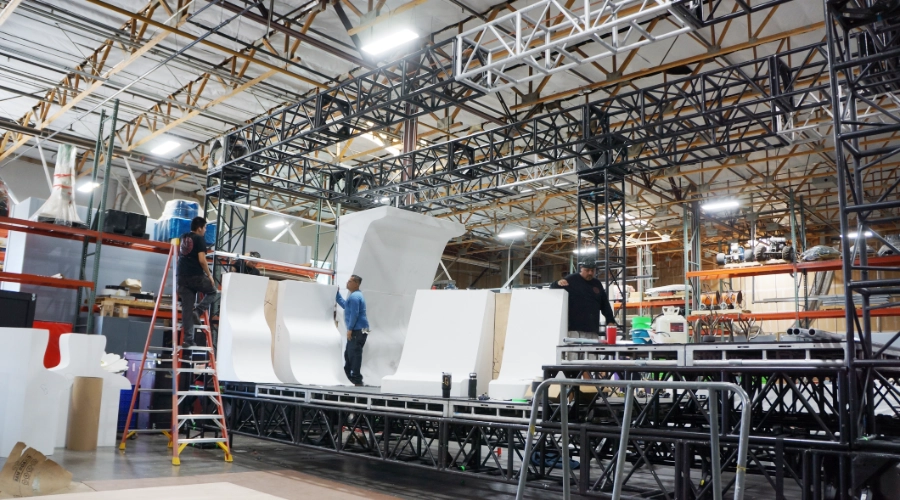
For example, a large festival stage might incorporate a structural steel framework, custom scenic architecture, CNC-cut foam details, fiberglass components, integrated signage, specialty finishes, and lighting infrastructure—all fabricated to work together.
6. Prototyping and Testing
Large event projects leave little room for surprises during installation.
Prototyping can help identify problems before they reach the event site.
A fabrication team may produce:
- Full-scale mockups
- Partial assemblies
- Connection prototypes
- Scenic samples
- Finish samples
- Structural components
- Custom mechanisms
- Interactive elements
Components can also be test-fitted in the shop to confirm that pieces align correctly and that assembly procedures work as intended.
For large temporary structures, this can save significant time during installation when crews may have only a few hours or days to complete the build.
7. Scenic Fabrication and Finishing
Fabrication creates the structure. Scenic finishing creates the experience.
Large event environments often require surfaces that look like something completely different from the materials underneath them.
A steel frame might become a futuristic architectural installation. Foam may become carved stone. Fiberglass can become polished architectural forms. Wood can become a detailed branded environment.
Scenic finishing techniques can include:
- Faux finishes
- Texturing
- Painting
- Airbrushing
- Aging
- Distressing
- Metallic finishes
- High-gloss finishes
- Custom graphics
- Specialty coatings
This is one of the areas where stage fabrication and traditional construction can differ significantly. Event structures frequently prioritize visual impact, portability, modularity, and rapid installation alongside structural performance.
8. Modular Design and Transportation
A structure that looks like one enormous installation may actually consist of dozens or hundreds of individual components.
Large event structures are often designed to break down into manageable sections for transportation and installation.
Fabricators consider:
- Truck dimensions
- Shipping weight
- Component size
- Loading sequence
- Site access
- Forklift access
- Crane requirements
- Assembly order
- Storage requirements
Designing with transportation in mind from the beginning can prevent costly modifications later.
A spectacular structure that cannot be efficiently transported or assembled is not a successful event fabrication project.
9. Installation on Site
Eventually, the project leaves the fabrication facility and heads to the event site.
This is where preparation becomes critical.
Installation crews may work alongside:
- Event producers
- General contractors
- Venue teams
- Rigging companies
- Electricians
- Audio teams
- Lighting departments
- Video production crews
- Other specialty contractors
Large structures may require cranes, forklifts, lifts, rigging equipment, and specialized installation crews.
Because event schedules are often extremely compressed, installation must be carefully sequenced. Every crew needs to understand what happens before, during, and after its portion of the build.
10. Event Operations and Support
The work does not necessarily end when the structure is standing.
Fabrication teams may remain involved throughout an event to address repairs, adjustments, maintenance, or last-minute modifications.
For multi-day festivals, concerts, conventions, and experiential events, having experienced fabrication support available can be particularly valuable.
11. Dismantling and Reuse
Unlike permanent construction, many event structures have a predetermined end date.
After the event, structures may need to be dismantled quickly and efficiently.
Components can potentially be:
- Reused at another event
- Modified for a new application
- Stored for future productions
- Repurposed into another structure
- Recycled
Designing for disassembly can make future reuse easier while reducing waste and fabrication costs over the life of a project.
What Makes Stage Fabrication Different?
Stage fabrication combines structural requirements with entertainment-driven design.
A stage may need to support performers and production equipment while also incorporating dramatic architectural elements, scenic backdrops, LED screens, lighting systems, special effects, branding, and audience-facing features.
The challenge is creating a structure that performs technically while looking extraordinary from every important viewing angle.
Large stages also require careful consideration of sightlines, access, backstage operations, equipment integration, load requirements, and installation logistics.
That makes stage fabrication a highly specialized form of event fabrication.
Designing Temporary Structures for Real-World Conditions
Temporary does not mean simple.
In many cases, temporary event structures must perform under demanding conditions despite being designed for a relatively short lifespan.
Outdoor events can introduce challenges such as:
- High winds
- Heat
- Dust
- Uneven surfaces
- Limited installation windows
- Heavy equipment traffic
- Large crowds
- Transportation restrictions
- Rapid weather changes
The structure must therefore be designed around the actual environment where it will operate—not simply how it appears in a rendering.
Why Fabrication Experience Matters
Large event structures involve far more than cutting materials and putting pieces together.
Successful projects require coordination between creative design, engineering, manufacturing, finishing, logistics, installation, and event production.
An experienced custom fabrication company can identify potential issues early, recommend more efficient construction methods, and coordinate multiple fabrication disciplines into one cohesive production process.
That experience becomes especially valuable when deadlines are tight and the cost of an installation delay can be significant.
Bringing Big Ideas to Life
The most memorable events often begin with ideas that seem difficult—or even impossible—to build.
A massive stage. An immersive environment. A sculptural entrance. A branded architectural installation. An interactive experience. A temporary structure that completely transforms a venue.
Turning those concepts into reality requires a fabrication partner capable of moving seamlessly from concept to engineering, fabrication, finishing, transportation, and installation.
At Statement Fabrication, we bring multiple fabrication disciplines together to create large-scale environments, stages, exhibits, experiential installations, and custom structures for events and entertainment.
Based in Las Vegas, we combine advanced manufacturing capabilities with hands-on fabrication expertise to build structures designed to make an impact—and perform when it matters.
From the first concept to completion, we build statements.