


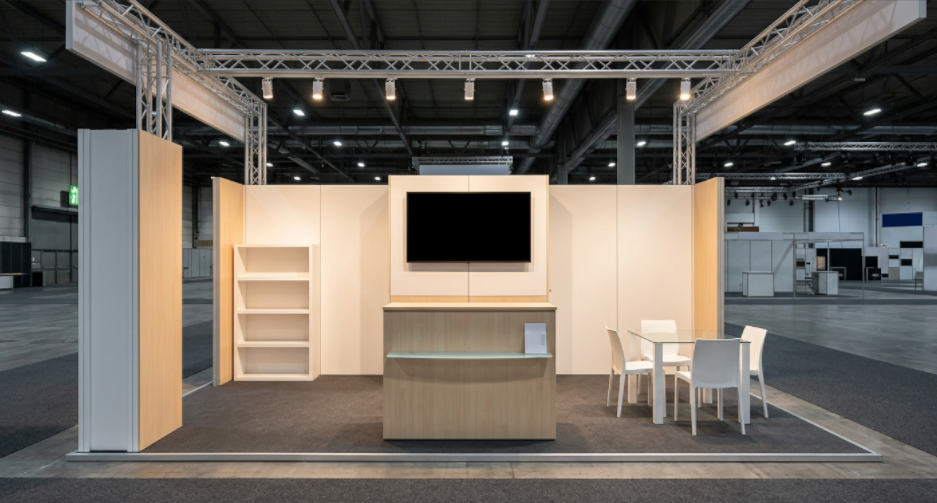
A custom exhibit is often one of the most visible ways a company presents its brand, products, and ideas. Whether it is a trade show booth, corporate display, product launch installation, museum exhibit, or custom presentation environment, the finished work reflects the organization behind it.
That makes choosing the right exhibit fabrication company an important decision.
The right partner should be able to understand the vision, recognize the practical challenges, recommend appropriate fabrication methods, and produce work that meets the project’s expectations.
But with so many different types of manufacturers, display companies, and fabrication shops available, how do you determine which one is right for your project?
The answer starts with understanding what your project requires and evaluating a potential partner’s capabilities beyond the appearance of their portfolio.
1. Look for Relevant Fabrication Experience
One of the first things to evaluate is whether a fabrication company has experience producing projects similar to yours.
A company that specializes in basic trade show displays may not have the equipment or experience required for a large sculptural installation. A shop focused primarily on metal fabrication may not have the capabilities needed for an exhibit involving custom millwork, foam sculpting, or fiberglass.
Look beyond general claims and examine actual completed work.
Consider whether the company has experience with:
- Custom trade show booths and exhibits
- Branded displays and product presentations
- Large-format sculptural elements
- Custom architectural and decorative features
- Museum and educational exhibits
- Complex multi-material projects
- Specialty props and dimensional components
Relevant experience helps demonstrate that a company understands the challenges associated with your type of project.
It is also worth asking about the specific work the fabricator performed. Some projects involve several different companies, designers, contractors, and suppliers. Understanding which portions were actually fabricated by the company helps you make a more accurate evaluation.
2. Evaluate In-House Fabrication Capabilities
Custom exhibits frequently involve more than one material or manufacturing process.
A project might require a welded metal framework, custom millwork, sculpted foam components, fiberglass features, and precision-cut specialty parts.
When these capabilities are available under one roof, it can create opportunities for better coordination between fabrication disciplines.
Look for a company with experience in the processes relevant to your project, such as:
Metal Fabrication
Metal fabrication supports structural components, platforms, frameworks, brackets, and decorative elements.
Capabilities may include laser cutting, forming, welding, and custom metal assembly.
Carpentry and Millwork
Custom millwork is commonly used for display fixtures, counters, cabinetry, finished panels, and architectural features.
Foam Sculpting and CNC Carving
Foam sculpting can create large-scale shapes, dimensional elements, custom props, and sculptural displays.
CNC and robotic cutting technology can help produce intricate forms with precision.
Fiberglass Fabrication
Fiberglass can be used to create custom curves, sculptural features, specialty forms, and finished components.
3D Printing and Prototyping
3D printing can support the development of specialty components, prototypes, and complex details.
Laser Cutting and Precision Manufacturing
Laser cutting and other CNC processes can help produce accurate parts from digital designs.
Not every company needs to perform every process internally. However, understanding which capabilities are in-house and which are outsourced can help you evaluate the company’s actual production resources.
3. Consider the Company’s Technology and Equipment
Technology plays an increasingly important role in modern fabrication.
Digital modeling, CNC manufacturing, laser cutting, 3D printing, and robotic equipment can expand the range of designs a fabrication company is capable of producing.
When evaluating a potential partner, consider how its equipment and technology relate to your project.
Questions worth asking include:
- Does the company use 3D modeling or digital design tools?
- Does it have CNC manufacturing capabilities?
- Can it produce complex or unconventional shapes?
- Does it have equipment suited to the materials in your design?
- Can it manufacture detailed components with consistent dimensions?
- Does it have the technology needed to support the project’s scale?
Advanced equipment alone does not guarantee a quality result. The people operating that equipment and the processes used to control quality are equally important.
The strongest fabrication operations combine modern technology with experienced professionals who understand how to use it effectively.
4. Look for Strong Design and Technical Collaboration
An exhibit may begin with a rendering, drawing, sketch, or even a general idea.
A good fabrication partner should be able to review the available information and identify the practical considerations involved in producing the work.
This includes evaluating materials, dimensions, manufacturing methods, component relationships, and potential production challenges.
Three-dimensional modeling can be particularly valuable when an exhibit includes complex geometry or multiple connected components.
Before moving forward, clarify what design-related services the company actually provides.
Some fabricators specialize in manufacturing from client-supplied drawings. Others may offer modeling, design assistance, prototyping, or broader development support.
If your project requires professional structural engineering, architectural services, electrical design, or specialized approvals, confirm who is responsible for those services and whether appropriately qualified professionals are involved.
Clear expectations help prevent confusion later in the project.
5. Examine Craftsmanship and Attention to Detail
The quality of an exhibit is often determined by the details.
A design may be impressive, but poor fabrication can undermine the entire presentation.
Look closely at examples of a company’s completed work.
Pay attention to:
- Consistency of finishes
- Clean edges and transitions
- Accurate dimensions
- Quality of welds and connections
- Alignment of components
- Surface preparation and paint quality
- Integration of different materials
- Overall fit and finish
If possible, examine completed projects in person or request detailed photographs.
It is also useful to ask how the company evaluates finished components and handles quality issues.
A strong fabrication partner should understand that the details are not separate from the design. They are part of what makes the finished exhibit successful.
6. Understand How the Company Approaches Complex Projects
Custom fabrication is rarely a completely predictable process.
Unusual designs, specialized materials, tight spaces, and challenging manufacturing requirements can all introduce complications.
A company’s ability to solve problems is therefore an important consideration.
Ask how the team approaches projects that involve unfamiliar shapes, multiple materials, or complicated fabrication requirements.
Do they evaluate different manufacturing methods? Can they identify potential challenges before production begins? Are they willing to explore alternatives when the original approach is impractical?
A capable fabrication team should be comfortable thinking through difficult problems and finding practical ways to achieve the intended result.
This is particularly important for projects that go beyond standard display systems or conventional construction.
7. Evaluate Communication and Project Coordination
Even a technically capable fabrication company can become difficult to work with if communication is inconsistent.
Before selecting a partner, understand how project information will be exchanged and how decisions will be handled.
Consider asking:
- Who will be the primary point of contact?
- How are design changes communicated?
- How are specifications and revisions documented?
- How will production progress be communicated?
- Who is responsible for coordinating outside services?
- What happens if a manufacturing issue is identified?
Complex projects benefit from clear expectations and organized communication.
You should also clarify the scope of services. Fabrication, finishing, assembly, transportation, and installation are separate activities that may or may not be included in a proposal.
Never assume that a service is included simply because it is commonly associated with an exhibit project.
8. Review the Company’s Portfolio Carefully
A portfolio is one of the best ways to understand a fabrication company’s capabilities.
However, it is important to look beyond the most impressive photographs.
Ask yourself:
- Does the work demonstrate the type of fabrication my project requires?
- Are there examples of similar materials and finishes?
- Does the portfolio show complex or custom-built components?
- Can the company explain its role in the completed projects?
- Is there evidence of consistency across different types of work?
A diverse portfolio can be valuable because it demonstrates the ability to work across different materials, applications, and fabrication challenges.
For highly customized projects, the ability to adapt is often just as important as experience with a specific product.
9. Compare Proposals Beyond the Price
Cost is an important part of any project, but the lowest estimate is not necessarily the best value.
When comparing proposals, make sure you understand what each company is actually providing.
Differences may include:
- Materials and material specifications
- Fabrication methods
- Included components
- Finish requirements
- Production quantities
- Quality expectations
- Design or modeling services
- Assembly requirements
- Transportation and installation
- Project schedule
A proposal with a lower price may reflect a different material, reduced scope, simpler finish, or fewer included services.
The best comparison is between proposals that clearly define the same expectations.
A well-defined scope helps avoid misunderstandings and makes it easier to evaluate the true value of each option.
Questions to Ask Before Hiring an Exhibit Fabricator
Before committing to a fabrication partner, consider asking these questions:
- What types of exhibits and custom displays have you fabricated?
- Which fabrication processes do you perform in-house?
- What equipment and technology do you use?
- Can you work from existing drawings, models, or concept images?
- What design, modeling, or prototyping services are available?
- How do you approach projects that involve multiple materials?
- How do you review quality and finished components?
- What services are included in your proposal?
- Which services require outside contractors or separate agreements?
- What information do you need to prepare an accurate estimate?
The answers should give you a clearer understanding of the company’s capabilities, limitations, and approach to the work.
Why Statement Fabrication Is Worth Considering
Statement Fabrication is a Las Vegas-based custom fabrication company built around the ability to turn ambitious ideas into physical reality.
Our operation brings together multiple fabrication disciplines, including metal fabrication, carpentry and millwork, fiberglass, CNC foam sculpting, 3D printing, laser cutting, and 3D modeling.
That range of capabilities allows us to approach custom exhibit projects with flexibility. Different materials and manufacturing methods can be considered together rather than limiting the project to a single process.
We also believe that technology is only part of the equation.
Our team is our greatest asset. The experience, creativity, craftsmanship, and dedication of the people doing the work are what make challenging projects possible.
We enjoy taking on projects that require creative problem-solving and careful execution. Whether the project involves a custom display, a large sculptural feature, or a complex multi-material exhibit, our goal is to produce work that reflects the original vision and meets the expectations of the client.
For organizations looking for a custom fabrication partner in Las Vegas, Statement Fabrication offers a broad range of capabilities under one roof.
Frequently Asked Questions About Choosing an Exhibit Fabrication Company
What makes a good exhibit fabrication company?
A good exhibit fabrication company combines relevant experience, capable equipment, skilled employees, quality craftsmanship, clear communication, and the ability to understand and execute the project’s requirements.
Should I choose a fabricator with in-house capabilities?
In-house capabilities can provide advantages when a project requires multiple materials and manufacturing processes. They may also make coordination between fabrication disciplines easier. However, the most important consideration is whether the company can deliver the required scope and quality.
How do I know if a fabrication company can handle a complex exhibit?
Review its portfolio, ask about similar projects, and discuss the specific manufacturing challenges involved. Ask which processes are performed internally and which require outside resources.
Is the cheapest exhibit fabrication quote the best option?
Not necessarily. Different estimates may include different materials, finishes, components, and services. Compare proposals carefully to understand what is included and whether each meets the same specifications.
Should an exhibit fabricator help with design?
That depends on the company and the project. Some fabricators work primarily from completed drawings, while others provide modeling, prototyping, or design collaboration. Confirm the available services before beginning.
Why is 3D modeling useful when choosing a fabricator?
3D modeling can help communicate the intended design, evaluate dimensions, coordinate components, and identify manufacturing considerations before production begins.
Can one fabrication company build an exhibit using several materials?
Yes. A multi-disciplinary fabrication company may be able to combine metal, wood, foam, fiberglass, plastics, and other materials within one project.
Does Statement Fabrication work on custom exhibit projects?
Statement Fabrication provides a broad range of custom fabrication capabilities that can support exhibit projects, including metal fabrication, millwork, fiberglass, foam sculpting, 3D printing, laser cutting, and 3D modeling.
Looking for an Exhibit Fabrication Partner?
Choosing the right fabrication company can make a significant difference in the success of your exhibit.
Look for a partner that understands the vision, has the capabilities to produce the work, and values the craftsmanship required to make the finished product stand out.
Statement Fabrication is built for ambitious ideas and challenging custom fabrication projects.
If you’re developing a trade show exhibit, custom display, product showcase, or another unique presentation, let’s discuss what we can build together.
Statement Fabrication — We Build Statements.