


Beyond Standard Office Design: What Custom Corporate Fabrication Makes Possible
A corporate office can be functional without being distinctive. Standard desks, conventional partitions, and basic wall graphics may provide the essentials, but they do not always communicate the personality, ambition, or identity of the organization occupying the space.
Custom corporate fabrication creates another possibility.
Instead of adapting a business environment entirely around standard products, custom fabrication makes it possible to build features specifically for the company’s brand, architecture, and intended experience.
A reception area can become a visual centerpiece. A conference room can incorporate custom architectural details. A showroom can feature one-of-a-kind product displays. An ordinary hallway can become a branded environment that communicates the company’s history and culture.
At Statement Fabrication, we help businesses explore what is possible when design ideas are supported by a broad range of fabrication capabilities.
Custom Corporate Reception Areas
The reception area is often the first opportunity to make a physical impression on customers, partners, employees, and visitors.
Custom fabrication can turn this space into a recognizable part of the company’s identity.
Possible features include:
- Custom reception desks and counters
- Dimensional company logos and lettering
- Sculptural backdrops and branded feature walls
- Integrated lighting elements
- Specialty wall panels and architectural treatments
- Custom display cases and presentation features
- Unique material combinations and specialty finishes
A reception desk does not have to be a standard rectangular counter. It can incorporate curved forms, layered materials, integrated lighting, sculptural details, and finishes selected to complement the surrounding architecture.
The surrounding environment can be designed as part of the same visual concept, creating a cohesive entrance rather than a collection of separate elements.
Corporate Feature Walls and Architectural Installations
Feature walls are among the most versatile applications of corporate fabrication.
They can serve as a visual focal point, communicate company identity, define a particular area, or introduce architectural interest into an otherwise ordinary interior.
Custom possibilities include:
- Dimensional wall installations
- Layered geometric designs
- Sculpted architectural panels
- Branded wall features
- Integrated signage and lettering
- Decorative metalwork
- Specialty textures and finishes
- Three-dimensional company logos
- Backlit or illuminated features
Larger installations can incorporate multiple materials and fabrication techniques. Metal frameworks may support dimensional components, while carved foam, fiberglass, wood, or specialty finishes provide the visible design.
The result can be a feature that would be difficult or impossible to achieve with standard interior products.
Custom Corporate Signage and Dimensional Branding
Corporate branding does not need to remain flat.
Dimensional fabrication gives logos, lettering, symbols, and other brand elements physical depth and presence.
Examples include dimensional reception logos, oversized branded lettering, sculptural company symbols, interior wayfinding features, and custom installations that communicate corporate values or milestones.
Depending on the design, these elements can be fabricated from metal, wood, acrylic, fiberglass, foam, or combinations of materials.
Lighting and specialty finishes can also be incorporated to create additional visual impact.
The important consideration is consistency. Colors, proportions, materials, mounting methods, and finishes should support the company’s established brand standards.
Collaboration Spaces and Employee Environments
Corporate fabrication is not limited to spaces designed for visitors.
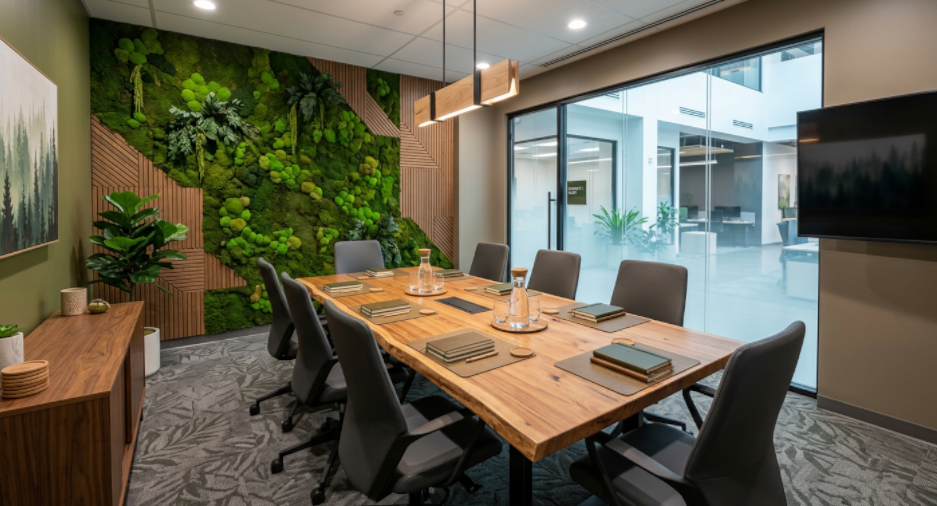
Employees interact with their workplace every day. Custom-built features can help make gathering spaces, collaboration areas, meeting rooms, and employee amenities more functional and visually cohesive.
Potential applications include:
- Custom collaboration tables and built-in features
- Branded employee lounges
- Specialty meeting room installations
- Architectural dividers and privacy screens
- Custom storage and millwork
- Employee recognition displays
- Innovation center features
- Multipurpose gathering spaces
- Decorative ceiling and wall treatments
These projects can be designed around the way employees use the space. A custom structure might define a collaborative zone, conceal equipment, provide integrated storage, or establish a visual connection between different departments.
The best solutions consider both appearance and everyday use.
Corporate Showrooms and Customer Experience Centers
Businesses that sell complex products or services often need more than a traditional office to communicate what they offer.
A corporate showroom or customer experience center can use custom fabrication to present products, demonstrate capabilities, and guide visitors through a carefully planned environment.
Fabricated features may include:
- Custom product display structures
- Oversized product models and replicas
- Interactive presentation stations
- Branded demonstration areas
- Architectural entry features
- Custom display cases
- Specialty lighting structures
- Dimensional storytelling installations
- Sculptural elements that reinforce the brand
In these environments, fabrication can help turn technical information or product features into physical experiences that visitors can see and understand.
A well-planned display should account for product dimensions, visitor access, lighting, durability, maintenance, and how the feature will be used during presentations.
Large-Scale Sculptural and Specialty Features
Some corporate projects call for something more ambitious than traditional millwork or signage.
Large-scale sculptures, dimensional brand elements, oversized architectural features, and custom-built installations can become defining elements of a headquarters, lobby, campus, or public-facing business environment.
These projects may involve complex geometry, unusual materials, internal frameworks, specialty coatings, and multiple fabrication disciplines.
For example, a large sculptural company symbol might begin as a digital model, be divided into production-ready components, and then be fabricated using a combination of metalwork, CNC foam carving, fiberglass, and finishing.
This is where advanced modeling and multidisciplinary fabrication can make ambitious concepts more achievable.
The Fabrication Processes Behind Custom Corporate Projects
Every project has its own requirements, but several fabrication disciplines are particularly useful for corporate environments.
Metal Fabrication
Metal fabrication can provide structural frameworks, decorative elements, custom supports, architectural details, and specialty fixtures. Steel and aluminum can be cut, formed, welded, and finished to meet specific design requirements.
Carpentry and Millwork
Custom millwork is useful for reception desks, cabinetry, built-ins, wall treatments, counters, conference room features, and other architectural elements.
Fiberglass Fabrication
Fiberglass allows for custom shapes, sculptural forms, specialty enclosures, and components that require complex contours or durable finished surfaces.
Foam Sculpting and CNC Carving
CNC foam carving can produce dimensional shapes, decorative architectural elements, oversized lettering, sculptures, and specialty forms. Coating and finishing systems are selected according to the final application.
3D Modeling and Printing
Digital modeling helps teams develop complex geometry, evaluate proportions, plan assemblies, and prepare parts for fabrication. 3D printing can be used for prototypes, detailed components, and specialty production needs.
Finishing and Detailing
Finishing brings the individual components together. Paint, textures, specialty coatings, metallic appearances, and other treatments can help create a consistent final appearance across different materials.
Planning a Custom Corporate Fabrication Project
The best time to involve a fabricator is early in the project.
Early collaboration allows the team to evaluate the concept, identify suitable materials, review dimensions, consider production methods, and determine how individual components will be assembled.
Important planning considerations include:
- Purpose: What should the fabricated feature accomplish?
- Design: Are drawings, renderings, or reference images available?
- Dimensions: How will the feature fit within the existing or planned space?
- Materials: What materials meet the visual, functional, and durability requirements?
- Construction: Does the design require internal support, structural engineering, or specialty fabrication?
- Site conditions: Are there access, ceiling-height, electrical, or building restrictions?
- Schedule: When must fabrication be complete, and what coordination is needed?
- Installation: Does the project require delivery, assembly, rigging, or on-site installation?
For permanent corporate interiors, the project team should also account for applicable building requirements, fire performance, accessibility, and any necessary engineering review.
Bringing Ambitious Corporate Concepts to Life
Custom corporate fabrication gives businesses the freedom to create environments that are recognizable, functional, and aligned with their identity.
Whether the project involves a custom reception area, an architectural centerpiece, a branded employee environment, or a large-scale sculptural installation, the right fabrication partner can help translate the concept into a buildable solution.
Statement Fabrication combines metal fabrication, carpentry and millwork, fiberglass, foam sculpting, 3D modeling and printing, and specialty finishing to support a wide range of custom builds.
Our team enjoys projects that challenge conventional approaches and require a combination of creativity, technical knowledge, craftsmanship, and execution.
If your next corporate project calls for something that cannot be purchased off the shelf, Statement Fabrication can help explore how to build it.
Contact our team to discuss your corporate fabrication project.
Frequently Asked Questions
What types of corporate projects can be custom fabricated?
Projects include reception areas, feature walls, branded interiors, architectural installations, displays, sculptures, and specialty workplace features.
Can custom fabrication create a complete branded office environment?
Fabricated elements can contribute to a cohesive branded environment, with project scope coordinated alongside designers and other construction professionals.
Can you fabricate custom reception desks?
Yes. Custom reception desks can incorporate unique shapes, multiple materials, integrated branding, specialty finishes, and project-specific features.
Can corporate fabrication include large sculptures?
Yes. Large-scale sculptures and dimensional brand features can be developed using modeling, metalwork, foam sculpting, fiberglass, and finishing.
What materials work best for corporate interiors?
Material selection depends on appearance, durability, weight, maintenance, location, and applicable building requirements.
Can custom corporate features incorporate lighting?
Lighting can be integrated into many fabricated features when planned with the appropriate electrical and installation coordination.
Can a fabricator work from architectural drawings?
Yes. A fabricator can review supplied drawings and coordinate fabrication details, materials, dimensions, and production requirements.
Does Statement Fabrication handle complex corporate builds?
Statement Fabrication offers multiple in-house fabrication disciplines to support complex custom features, specialty structures, and branded corporate environments.