


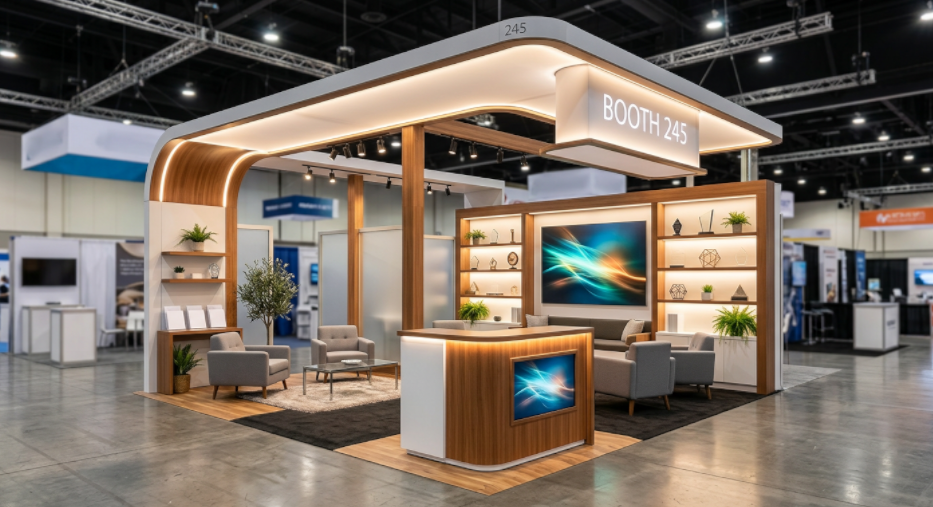
A trade show booth is more than a place to display a company logo. It is a physical representation of a brand, an opportunity to showcase products, and a space where businesses can connect with potential customers.
For companies looking to stand out in a crowded exhibition hall, custom trade show fabrication offers the flexibility to create something distinctive. Instead of choosing from a limited selection of standardized display components, businesses can develop an exhibit around their brand identity, products, messaging, and visitor experience.
From architectural booth structures and product displays to oversized props and interactive environments, custom fabrication opens the door to a wide range of possibilities.
What Can Be Built for a Custom Trade Show Booth?
The possibilities depend on the available space, project goals, design, budget, and event requirements. A custom exhibit can be relatively simple or involve multiple fabrication disciplines working together.
Here are some of the most common applications.
1. Custom Booth Structures and Architectural Features
The physical structure of a booth establishes its overall appearance and helps organize the space.
Custom-fabricated structures may include:
- Branded backwalls and feature walls
- Architectural frames and portals
- Overhead structures and decorative elements
- Columns, partitions, and dividers
- Custom ceilings and suspended features
- Reception areas and meeting spaces
- Specialty platforms and raised display areas
These components can be designed to create a strong visual presence while helping guide visitors through the exhibit.
Some larger or overhead structures may require engineering, venue approval, rigging coordination, or other specialized review. Those requirements should be considered during early planning.
2. Product Displays and Demonstration Stations
For many exhibitors, the products themselves are the primary attraction. Custom-fabricated displays can help present products in a way that supports the company’s sales and marketing objectives.
Examples include:
- Custom product pedestals
- Display platforms and shelving
- Protective display enclosures
- Product demonstration counters
- Specialty mounting structures
- Interactive product stations
- Custom display cases
- Integrated storage and cabinetry
A well-designed product display should consider more than appearance. It should also account for product dimensions, weight, visibility, access, security, and how visitors will interact with the item.
3. Dimensional Logos, Signage, and Branded Elements
Branding is one of the most important parts of a trade show exhibit. While printed graphics are useful, dimensional elements can add depth, texture, and visual impact.
Custom branded components may include:
- Three-dimensional company logos
- Oversized lettering
- Dimensional signage
- Sculpted brand symbols
- Custom-colored architectural features
- Branded counters and display surfaces
- Specialty signage structures
These elements can be produced using different materials and finishes depending on the design, size, weight, and intended application.
4. Custom Props and Sculptural Features
Sometimes the most memorable part of an exhibit is the feature visitors did not expect to see.
Large-scale props, sculptures, replicas, and themed elements can help create a recognizable focal point and encourage people to stop, look, and engage.
Examples include:
- Oversized product replicas
- Sculptural brand elements
- Custom characters and figures
- Themed props and environmental details
- Large dimensional objects
- Specialty display pieces
- Custom shapes and decorative features
Foam sculpting, CNC foam carving, fiberglass fabrication, metalwork, and 3D printing can all contribute to these types of projects.
5. Interactive and Experiential Exhibit Features
Many companies want their trade show presence to do more than communicate information. They want visitors to participate in a demonstration, explore a product, or experience the brand in a memorable way.
Custom fabrication can support these goals through:
- Interactive product displays
- Demonstration environments
- Custom touchscreen housings
- Specialty presentation stations
- Photo opportunities and branded backdrops
- Immersive themed environments
- Physical structures designed around digital content
Technology integration should be coordinated early so that screens, wiring, power access, ventilation, and equipment mounting can be incorporated into the physical design.
6. Custom Counters, Cabinetry, and Millwork
Counters and cabinetry help make an exhibit functional while contributing to its overall appearance.
Custom millwork can provide:
- Reception and welcome counters
- Product demonstration desks
- Storage cabinets
- Literature and sample displays
- Concealed equipment storage
- Meeting tables and work surfaces
- Custom shelving and built-in features
These elements can be designed to complement the exhibit’s architecture, finishes, and branding.
7. Specialty Materials and Finishes
One advantage of custom fabrication is the ability to combine materials to achieve a particular appearance or function.
Depending on the design, trade show exhibits may incorporate:
- Metal framing and decorative metal features
- Wood structures and finished millwork
- Fiberglass forms and specialty surfaces
- Sculpted foam and lightweight scenic elements
- Acrylic and transparent components
- 3D-printed details and custom shapes
- Paint, coatings, laminates, and specialty finishes
The best material choice depends on the required strength, weight, appearance, durability, transportation needs, and budget.
8. Large-Scale and Complex Exhibit Features
Some trade show projects call for components that are difficult to produce using standard exhibit systems. Unusual shapes, oversized structures, complex assemblies, and custom scenic features may require several fabrication disciplines.
A project might combine:
- Metal structures for support
- Carpentry for walls and cabinetry
- CNC foam carving for sculptural shapes
- Fiberglass for durable specialty forms
- 3D printing for detailed components
- Custom finishing for a consistent appearance
Having access to multiple fabrication capabilities can simplify coordination and make more ambitious designs possible.
Designing an Exhibit for Transportation and Reuse
A visually impressive exhibit also needs to work in the real world.
Many trade show structures are transported from a fabrication facility to a convention center, assembled under a tight schedule, and potentially moved to another event afterward.
That makes transportation and reusability important design considerations.
A fabricator should consider:
- Component dimensions and shipping constraints
- Weight and handling requirements
- Connections and assembly methods
- Protection of finished surfaces
- Storage requirements between events
- Whether components need to be modular
- How the exhibit may be adapted for future shows
A custom exhibit designed for one event may have different construction priorities than one intended for repeated use across a national trade show schedule.
Custom Fabrication vs. Standard Trade Show Display Systems
Standard exhibit systems can be an effective choice for businesses that need a simple, economical, or frequently reconfigured booth.
Custom fabrication becomes especially valuable when a company wants a distinctive appearance, unusual dimensions, specialty materials, large product replicas, integrated scenic elements, or a more immersive environment.
The right approach depends on the objectives of the exhibit. Some projects benefit from combining standardized components with custom-fabricated features rather than choosing one approach exclusively.
Why Work With a Fabricator That Offers Multiple Capabilities?
Trade show exhibits can involve many different materials and construction methods. A project with metal framing, custom millwork, sculpted foam, fiberglass features, and specialty finishes may require coordination between several vendors if those capabilities are not available through one fabrication partner.
A shop with a broad range of in-house capabilities can help bring these disciplines together.
Statement Fabrication is a Las Vegas custom fabrication company with capabilities that include metal fabrication, carpentry and millwork, fiberglass fabrication, custom foam sculpting, CNC processes, 3D modeling, and large-format 3D printing.
Our team works across a variety of industries and project types, producing custom structures, displays, scenic elements, and specialty fabricated components.
Whether you’re developing a traditional exhibit with custom features or an ambitious environment that needs multiple fabrication processes, we can help evaluate the concept and determine how to bring it into the physical world.
Frequently Asked Questions About Custom Trade Show Booths
Can a trade show booth be completely custom-built?
Yes. A booth can be designed and fabricated around a company’s brand, products, space, and event objectives.
What are custom trade show displays made from?
They may use wood, metal, aluminum, foam, fiberglass, acrylic, plastics, and specialty finishes.
Can you build oversized product replicas?
Custom fabricators can produce large product replicas using methods such as foam carving, fiberglass, metalwork, and 3D printing.
Can custom exhibits include interactive technology?
Yes. Displays can be designed to accommodate screens, touchscreens, lighting, product demonstrations, and other technology.
Are custom trade show booths reusable?
They can be. Reusability should be considered during design, including how components are transported, assembled, stored, and maintained.
Can one fabricator handle multiple materials?
Some fabrication shops offer multiple disciplines, allowing different materials and processes to be coordinated within a single project.
Can you fabricate from renderings or concept drawings?
A fabricator can often use renderings, drawings, and reference images as a starting point for evaluating and developing a project.
Does custom booth fabrication include shipping and installation?
Those services depend on the project agreement, event location, venue requirements, and logistics. They should be clearly defined in the project scope.
Let’s Build Something That Stands Out
Your next trade show is an opportunity to show people what makes your company different. A custom exhibit can help turn that opportunity into an environment that attracts attention, showcases your products, and gives visitors something memorable to experience.
If you have a booth concept, product display, custom prop, or larger exhibit environment in mind, contact Statement Fabrication. Send us your drawings, renderings, or even an early-stage idea.
Statement Fabrication — We Build Statements.