


A corporate environment is more than an office or commercial interior. It communicates a company’s identity, shapes how employees and visitors experience the organization, and creates a physical setting for collaboration, presentations, and customer engagement.
From impressive reception areas and branded headquarters to custom conference spaces, product showrooms, and executive environments, custom fabrication helps businesses create spaces that reflect who they are and what they stand for.
Corporate environment fabrication transforms workplace and commercial design concepts into custom-built architectural features, branded installations, specialty millwork, sculptural displays, and distinctive interior elements. By combining creative design with the right materials and fabrication methods, companies can develop environments that feel intentional, cohesive, and uniquely their own.
Based in Las Vegas, Nevada, Statement Fabrication provides custom fabrication capabilities for projects that call for distinctive forms, complex builds, and carefully executed finishes. Our team helps bring corporate design concepts into the physical world through carpentry and millwork, metal fabrication, fiberglass fabrication, foam sculpting, 3D printing, and other custom fabrication methods.
What Is Corporate Environment Fabrication?
Corporate environment fabrication is the custom production of physical features for offices, headquarters, corporate campuses, conference facilities, showrooms, visitor centers, and other business spaces.
Unlike standard office furnishings or off-the-shelf décor, custom-fabricated elements are developed around a company’s brand, architecture, functional requirements, and design objectives.
These projects may include:
- Custom reception desks and lobby features
- Branded walls and dimensional logos
- Architectural panels and decorative structures
- Conference room and presentation features
- Corporate history displays and recognition walls
- Product showcases and demonstration environments
- Sculptural installations and signature focal points
- Custom cabinetry, millwork, and specialty fixtures
- Employee collaboration spaces and themed interiors
Some projects involve a single focal feature, while others require multiple fabricated components that work together to create a consistent visual identity across an entire workplace or facility.
Custom Fabrication Ideas for Corporate Spaces
Every corporate environment serves a different purpose. A headquarters may need to communicate brand identity and company culture, while a customer-facing showroom may be designed to demonstrate products and support sales conversations. Custom fabrication helps tailor each space to its intended role.
Corporate Lobbies and Reception Areas
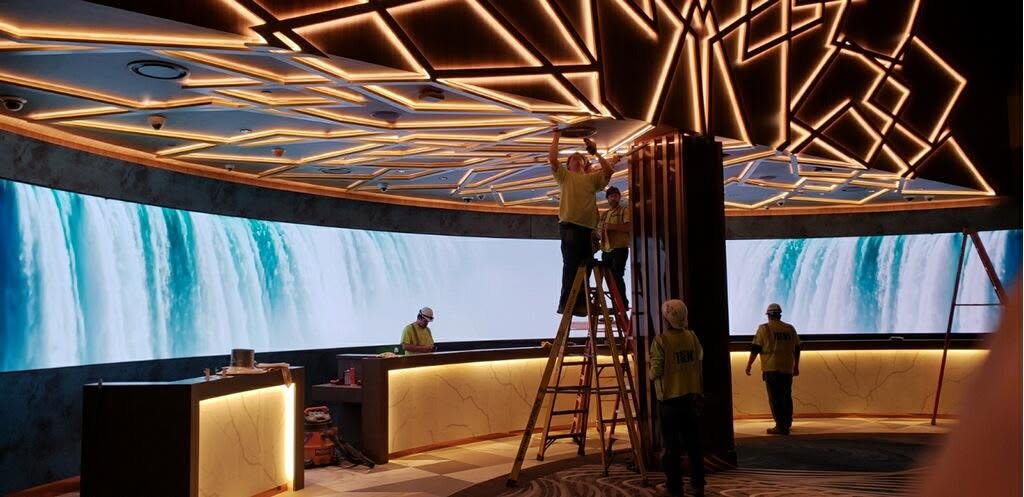
A reception area often establishes the first physical impression of a company. Custom reception desks, dimensional logos, feature walls, sculptural installations, and specialty finishes can create a welcoming and recognizable environment.
Fabricated elements can be designed around the architecture, available space, visitor flow, and desired brand aesthetic, whether the goal is understated sophistication or a bold architectural statement.
Branded Walls and Company Identity Features
Branded environments can communicate a company’s identity through more than signage alone. Dimensional lettering, custom wall panels, layered materials, decorative structures, and integrated display features can help bring brand colors, forms, and visual language into the physical space.
Consistency matters when these features extend across reception areas, meeting rooms, corridors, and shared spaces.
Conference Rooms and Presentation Spaces
Conference and presentation environments may incorporate custom wall treatments, display surrounds, specialty millwork, architectural accents, and features designed to complement audiovisual systems.
These elements can help create a polished setting for executive presentations, customer meetings, training sessions, and internal communications. Technical requirements should be coordinated early to account for screens, speakers, cameras, wiring, and equipment access.
Corporate History and Recognition Displays
Many organizations want to communicate their history, achievements, values, and milestones to employees, clients, and visitors. Custom-fabricated display structures, dimensional graphics, sculptural features, and integrated presentation elements can turn these stories into a physical part of the workplace.
The result can be more cohesive and engaging than a collection of unrelated signs or display cases.
Product Showrooms and Demonstration Environments
Companies that manufacture or sell physical products may need environments that allow visitors to examine products, understand their features, and see how they work.
Custom display platforms, product stands, demonstration structures, branded walls, and specialty fixtures can be tailored to the scale and requirements of the products being presented.
Employee Collaboration and Shared Spaces
Breakout areas, internal gathering spaces, training rooms, and employee lounges can also benefit from custom fabrication. Architectural dividers, custom millwork, decorative features, and integrated brand elements can help distinguish different areas while maintaining a cohesive workplace design.
Why Companies Invest in Custom Corporate Environments
The physical workplace can support business objectives when its design is connected to how the company operates and presents itself.
- Reinforce brand identity: Custom architectural features make brand values and visual identity part of the physical space.
- Create a stronger first impression: Distinctive reception areas and visitor spaces can communicate professionalism and attention to detail.
- Support company culture: Recognition displays, collaboration spaces, and branded interiors can reflect an organization’s history and priorities.
- Improve product presentation: Purpose-built showrooms and demonstration areas can make complex products easier to understand.
- Create a cohesive workplace: Coordinated materials, finishes, and architectural details help connect different areas of a facility.
- Accommodate unique requirements: Custom fabrication can address unusual dimensions, specific design goals, or features that standard products cannot readily provide.
The objective is not to make every corporate space elaborate. It is to identify where custom-built elements can provide meaningful visual or functional value.
Materials and Techniques for Corporate Fabrication
The materials and methods used in a corporate environment depend on the design intent, building conditions, expected use, maintenance needs, and budget.
| Material or technique | Potential corporate applications |
|---|---|
| Carpentry and custom millwork | Reception desks, cabinetry, counters, wall features, built-ins |
| Metal fabrication | Decorative frameworks, architectural details, display structures, custom supports |
| Fiberglass fabrication | Sculptural features, complex shapes, specialty decorative components |
| CNC foam carving | Lightweight sculptural elements, dimensional forms, custom decorative features |
| 3D printing | Intricate details, custom components, prototypes, complex geometries |
| CNC cutting and machining | Precision-cut panels, repeatable parts, patterns, specialty components |
| Specialty finishing | Custom textures, simulated materials, coordinated colors, distinctive surfaces |
Multiple materials can be combined to achieve a specific appearance or meet practical requirements. For example, a decorative wall feature may combine millwork with metal details, while a sculptural centerpiece may use a shaped body with a separate support system.
Material selection should account for durability, cleaning, expected contact, fire and life-safety requirements where applicable, and the level of maintenance the finished feature will require.
How Corporate Environment Fabrication Works
Successful projects require collaboration between designers, corporate stakeholders, architects, contractors, and fabricators. Early coordination helps ensure that custom features fit both the design vision and the realities of the building.
1. Establish the project’s objectives. Identify the purpose of the space, the intended audience, the desired brand impression, and the features that matter most.
2. Review designs and site conditions. Evaluate drawings, renderings, dimensions, material specifications, existing architecture, and relevant building constraints.
3. Develop fabrication details. Determine materials, construction methods, attachment approaches, finishes, and how each component will interact with surrounding building systems.
4. Fabricate custom components. Produce the parts using the appropriate combination of millwork, metal fabrication, CNC machining, foam sculpting, 3D printing, fiberglass, and finishing techniques.
5. Inspect fit and finish. Review dimensions, alignment, surface quality, and consistency with approved design intent before the components leave the fabrication facility.
6. Coordinate delivery and installation. Plan transportation, access, assembly requirements, and coordination with other trades. Confirm in advance which delivery, assembly, and installation services are included in the project scope.
For projects in occupied offices or operating facilities, scheduling and work-area restrictions may also affect how the work is delivered.
Planning a Corporate Fabrication Project
Custom-built corporate features are often part of a larger interior construction or renovation project. Addressing practical details early helps keep the design, fabrication, and construction teams aligned.
- Define the design priorities. Determine which areas need the greatest visual impact and which features serve a practical purpose.
- Establish brand standards. Share approved colors, logos, typography, finishes, and other brand requirements.
- Coordinate with the building design. Confirm dimensions, attachment conditions, clearances, accessibility, and interfaces with existing architecture.
- Plan for technology. Account for screens, lighting, audiovisual equipment, power, cable routing, and maintenance access.
- Consider daily use. Evaluate cleaning, durability, employee interaction, visitor flow, and long-term maintenance.
- Set a realistic schedule. Allow time for design approval, samples, fabrication, finishing, construction coordination, and site access.
- Clarify project responsibilities. Establish who handles engineering, permits, transportation, installation, and coordination with contractors.
For larger or more complex installations, engineering and site-specific professional review may be required. Fabrication plans should be coordinated with the appropriate project professionals to address applicable building, fire, accessibility, and life-safety requirements.
Corporate Renovations and Workplace Refreshes
Custom fabrication is not limited to new corporate headquarters or major construction projects. Existing offices, showrooms, and commercial spaces can benefit from targeted improvements that refresh the environment without replacing everything.
A new reception feature, custom branded wall, sculptural centerpiece, recognition display, or product presentation area can change how a space feels and functions.
Renovation projects require an assessment of existing conditions, dimensions, attachment points, access, and any building systems that may affect the work. Fabricated features should be designed to integrate with the space rather than assume that existing conditions match original drawings.
A focused fabrication project can also be planned around phased construction or limited access, depending on the facility and agreed project scope.
Corporate Environment Fabrication by Statement Fabrication
Statement Fabrication helps businesses and design teams turn distinctive concepts into physical spaces through custom fabrication capabilities in Las Vegas, Nevada.
Our capabilities include custom fabrication, 3D modeling and printing, fiberglass fabrication, metal fabrication, carpentry and millwork, and custom foam sculpting. These methods can support corporate lobbies, branded architectural features, specialty displays, sculptural installations, product showrooms, and other custom-built workplace elements.
We work with project teams to understand the design intent, explore appropriate fabrication methods, and develop a practical approach to materials, production, and coordination.
Whether you are building a new headquarters, updating a customer-facing space, creating a product showroom, or adding a signature feature to an existing office, Statement Fabrication can help you explore the possibilities.
Planning a corporate environment or workplace renovation? Contact Statement Fabrication to discuss your project and discover how custom fabrication can bring your design vision to life.
Frequently Asked Questions
What is corporate environment fabrication?
Corporate environment fabrication is the custom production of architectural features, branded installations, specialty millwork, displays, and other physical elements for offices and business facilities.
What can be custom fabricated for a corporate office?
Common projects include reception desks, branded walls, dimensional logos, decorative panels, recognition displays, conference room features, custom cabinetry, and sculptural installations.
Can custom fabrication help reinforce company branding?
Yes. Custom-fabricated features can incorporate a company’s visual identity, colors, materials, logos, and design language into the physical workplace.
Can custom fabrication be used in existing offices?
Yes. Custom features can be designed for renovations and workplace refreshes, subject to existing dimensions, building conditions, access, and project requirements.
What materials are commonly used for corporate environments?
Wood, metal, fiberglass, foam, and 3D-printed components are potential options. The best material depends on the design, durability, appearance, location, and intended use.
Can custom features incorporate screens and audiovisual technology?
Yes. Fabricated features can be designed to accommodate screens and other equipment, provided the relevant technical, electrical, access, and installation requirements are coordinated.
When should a fabricator be involved in a corporate interior project?
Early involvement is recommended, particularly when the design includes complex shapes, custom architectural features, specialty finishes, or integration with building systems.
Does Statement Fabrication provide installation for corporate projects?
Project scope varies. Discuss delivery, assembly, installation, and coordination responsibilities with Statement Fabrication to establish which services are included.