


In film and television, sometimes the smallest object can become one of the most important things on screen.
A distinctive piece of technology. A fictional artifact. An oversized product. A highly detailed replica. A custom piece of furniture. A sculptural object that exists nowhere else in the real world.
These aren’t simply props. They are physical pieces of the story.
Statement Fabrication creates custom props and hero pieces for film, television, commercials, branded content, and other productions where ordinary objects simply aren’t enough.
From highly detailed hero props to large-scale specialty pieces, we combine traditional craftsmanship with advanced fabrication technology to turn creative concepts into camera-ready objects.
What Is a Hero Prop?
In production, not every prop receives the same level of attention.
Background objects may only appear briefly or at a distance. A hero prop, on the other hand, is typically a featured object that receives significant screen time or plays an important role in a scene.
The camera may move in close.
An actor may handle it.
The audience may see its smallest details.
It may need to be repeatedly used during filming.
That changes everything about how the piece should be fabricated.
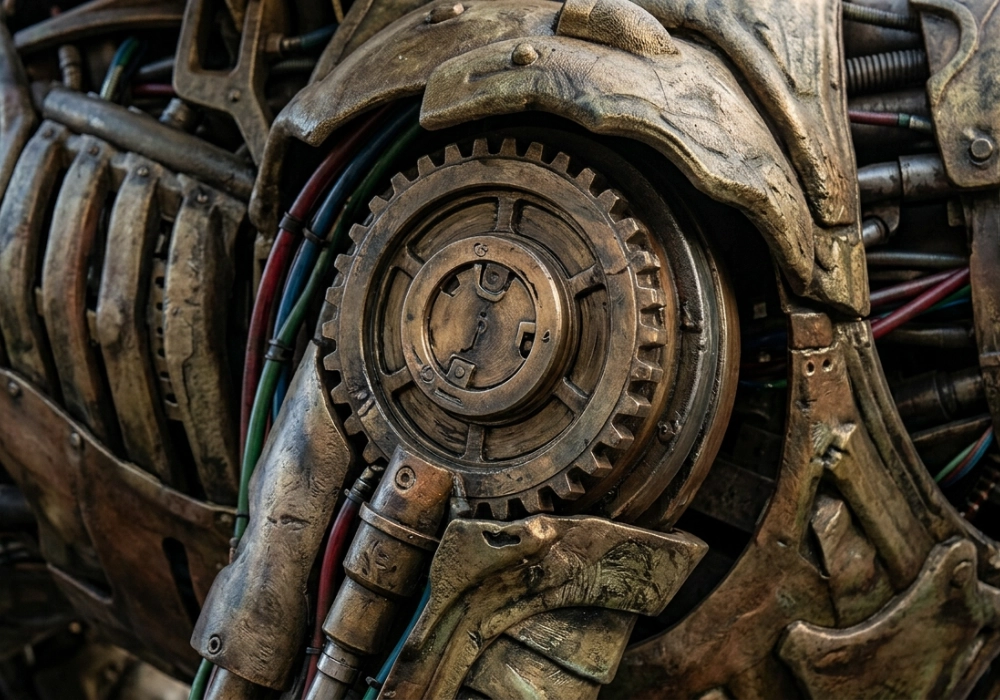
A hero piece needs to look convincing from the camera’s perspective while also functioning within the demands of production. That can mean carefully engineered construction, durable materials, precise detailing, realistic textures, specialized finishes, and sometimes integrated mechanical, electronic, or lighting elements.
When the camera is going to notice it, the fabrication needs to be able to stand up to the camera.
Turning Concept Art Into a Physical Prop
Many custom props begin as an idea rather than an object that already exists.
The starting point could be:
- Concept artwork
- A production designer’s sketch
- A 3D rendering
- A digital model
- A photograph or reference object
- A physical prototype
- A description of a fictional object
- An existing prop that needs to be replicated or modified
The fabrication challenge is turning that creative direction into something that can actually be built.
Our process can begin with 3D modeling and digital development, allowing complex shapes and components to be evaluated before fabrication starts.
This is particularly useful when a prop needs to be reproduced at an exact scale, modified for production, manufactured in multiple versions, or designed around specific materials and fabrication techniques.
The result is a smoother transition from concept → model → prototype → finished prop.
Props Built for the Camera
A prop that looks convincing on a computer screen isn’t necessarily ready for production.
Film and television introduce a unique set of requirements.
The prop may need to be:
- Photorealistic
- Lightweight enough to handle
- Durable enough for repeated takes
- Sized specifically for the camera
- Built around an actor’s interaction
- Easily transported
- Replicated for multiple units
- Finished to withstand close-up photography
- Modified for special effects or production requirements
These considerations are incorporated into the fabrication process from the beginning.
For example, a prop that appears to be made from solid metal might actually use a lightweight fabricated structure. A massive stone object might be CNC-cut from foam and finished to look like carved rock. A futuristic device could combine 3D-printed components, machined or fabricated elements, lighting, and custom finishing.
The objective isn’t always to build the object exactly as it would exist in the real world. The objective is to build the object in the smartest way possible so it looks exactly right on screen.
Fabricating Original Props From Scratch
Some of the most interesting film and television props don’t exist anywhere outside the production.
They’re entirely original.
Futuristic technology. Fantasy artifacts. Fictional machinery. Oversized objects. Imaginary architectural details. Creatures. Sculptures. Branded products that exist only within a fictional world.
These projects require more than conventional manufacturing.
There may be no off-the-shelf component to start with and no existing product to use as a reference. The fabrication team has to interpret the design and determine how to physically construct something that has never existed before.
That’s where a combination of design, engineering, craftsmanship, and fabrication technology becomes particularly valuable.
Replicas, Reproductions & Screen-Accurate Details
Other productions require recreating something that already exists.
A historical object may need to be reproduced for a period production. A real-world product may need to be recreated at a different scale. An existing architectural element may need to be duplicated for filming.
Replicas can range from relatively straightforward reproductions to extraordinarily detailed pieces requiring multiple fabrication processes.
Digital modeling, CNC machining, 3D printing, molding, fiberglass, metal fabrication, foam sculpting, and specialty finishing can all play a role.
The closer the camera gets, the more important those details become.
Edges, seams, textures, surface transitions, hardware, proportions, and finishes that might be invisible in a wide shot can become extremely noticeable in a close-up.
Oversized Props & Large-Scale Hero Pieces
Not every hero piece fits on a tabletop.
Film and television productions sometimes call for enormous objects designed to dominate a scene.
Statement Fabrication can build large-format props and sculptural pieces using a combination of structural fabrication, CNC technology, foam sculpting, fiberglass, metal fabrication, carpentry, and other specialized processes.
Large-scale props can include:
- Oversized product replicas
- Giant sculptures
- Architectural objects
- Fictional machinery
- Large creatures and character elements
- Vehicles and vehicle components
- Monumental artifacts
- Commercial display pieces
- Interactive objects
- Large scenic elements
Scale introduces another level of engineering and fabrication complexity.
The finished piece needs to maintain its intended shape, survive handling and transportation, and ultimately look right when placed in the production environment.
Foam Sculpting for Film & TV Props
Foam is one of the most versatile materials for creating large, lightweight forms.
With CNC foam cutting and robotic sculpting capabilities, complex shapes can be produced with a level of consistency and precision that would be difficult to achieve through purely manual carving.
Foam can be used to create everything from large architectural details to sculptural objects, creatures, oversized replicas, specialty shapes, and other custom forms.
The finished piece can then be coated, hardened, painted, textured, or otherwise finished to achieve the desired appearance.
The result can look like stone, wood, metal, concrete, carved sculpture, or virtually any other surface required by the production.
3D Printing for Custom Props
3D printing has become an increasingly useful tool for custom prop fabrication because it allows highly complex components to be produced directly from digital designs.
It can be particularly effective for:
- Intricate mechanical details
- Repeated components
- Custom enclosures
- Fictional technology
- Small hero props
- Sculptural components
- Prototype development
- Replacement parts
- Custom detailing
- Highly complex geometries
3D printing also makes it possible to rapidly move from a digital concept to a physical prototype.
That can be extremely valuable when a production schedule doesn’t leave room for lengthy traditional tooling or when the design needs to be tested and modified before the final version is fabricated.
Metal Fabrication & Specialty Prop Construction
Some props need more than visual realism.
They need structural strength.
Metal fabrication can provide the framework or finished exterior for props that will experience repeated handling, transportation, movement, or interaction.
Custom welding, formed metal, CNC-cut components, tube fabrication, and other metalworking techniques can be incorporated into a prop when strength and durability matter.
Metal can also be combined with lighter materials to create the appearance of a heavy or solid object without necessarily making the finished piece unnecessarily difficult to handle.
The fabrication strategy is determined by the demands of the production.
Fiberglass & Composite Props
Fiberglass is another valuable material for custom film and television props.
It can produce strong, lightweight shells and complex forms while providing a surface that can be finished to a wide variety of appearances.
Fiberglass fabrication can be useful for:
- Sculptural props
- Large character pieces
- Architectural components
- Oversized replicas
- Product replicas
- Vehicle components
- Durable scenic elements
When weight, strength, shape, and finish all matter, composite construction can offer significant advantages.
The Finish Is Part of the Illusion
Fabricating the shape is only half the job.
The finish is often what makes the audience believe the object is real.
A newly fabricated prop may need to look ancient, weathered, industrial, futuristic, polished, damaged, burned, corroded, hand-crafted, or mass-produced.
Surface treatment can dramatically change how a material reads on camera.
A lightweight foam sculpture can become convincing stone. A fiberglass shell can appear to be cast metal. A newly fabricated wooden element can be made to look decades old.
Paint, texture, aging, distressing, coatings, and other finishing techniques help transform fabricated components into believable objects within the production’s world.
One Prop May Require Multiple Fabrication Disciplines
The most ambitious props rarely come from a single process.
A single hero piece might involve:
3D modeling → CNC cutting → metal fabrication → foam sculpting → fiberglass → 3D printing → assembly → paint → specialty finishing.
That is why having access to multiple fabrication capabilities can make a significant difference.
Instead of designing the project around one manufacturing method, the fabrication team can determine which combination of techniques produces the best result.
At Statement Fabrication, our capabilities include 3D modeling and design, 3D printing, CNC cutting, metal fabrication, carpentry and millwork, foam sculpting, fiberglass fabrication, and finishing.
That allows us to approach unusual props as fabrication problems to solve rather than forcing creative concepts into predetermined processes.
Built for Production, Not Just Display
A beautiful prop isn’t necessarily a successful production prop.
Film and television pieces can be subjected to repeated handling, transportation, setup, rehearsal, multiple takes, camera repositioning, and sometimes demanding interaction with performers.
That means durability and practicality matter.
A hero piece should be designed around how it will actually be used.
Does an actor need to hold it?
Will it be repeatedly moved?
Does it need to come apart for transportation?
Does it need multiple identical versions?
Will it be filmed from several angles?
Does it need to accommodate lighting or electronics?
Will the camera see it from only a few feet away?
These questions can influence everything from material selection to internal construction.
Multiple Versions of the Same Prop
Productions may require more than one version of a featured prop.
There may be a pristine hero version, a stunt version, a lightweight version, a damaged version, or several identical pieces needed simultaneously for different scenes.
Digital modeling and modern fabrication technologies can make replication considerably more efficient.
Once the geometry and construction methodology are established, additional versions can be produced with greater consistency.
This can be particularly useful for productions where continuity matters or where a single hero prop is too valuable or fragile to use for every production requirement.
When the Prop Becomes the Star
Some objects become inseparable from the productions they’re created for.
They’re recognizable.
They’re photographed.
They’re remembered.
They’re the objects audiences talk about after the credits.
That is the opportunity—and the responsibility—of a hero piece.
It has to communicate something immediately. It may establish a character, define a fictional world, create a visual signature, or become an essential part of a scene.
At that point, the prop isn’t merely decoration.
It becomes part of the storytelling.
From Digital Concept to Physical Reality
At Statement Fabrication, we specialize in building things that don’t already exist.
For film and television productions, that means taking ambitious creative concepts and determining how to physically bring them into the real world.
Whether you need a highly detailed hero prop, an oversized replica, a fictional artifact, a sculptural centerpiece, or a collection of production-ready specialty pieces, our fabrication capabilities allow us to approach the project from multiple angles.
We combine advanced technology, engineering, craftsmanship, and fabrication experience to create objects that are built for the demands of production and designed to look right when the camera rolls.
Have a prop that doesn’t exist yet?
That’s where we come in.
Talk to Statement Fabrication about your next film or television prop fabrication project.